
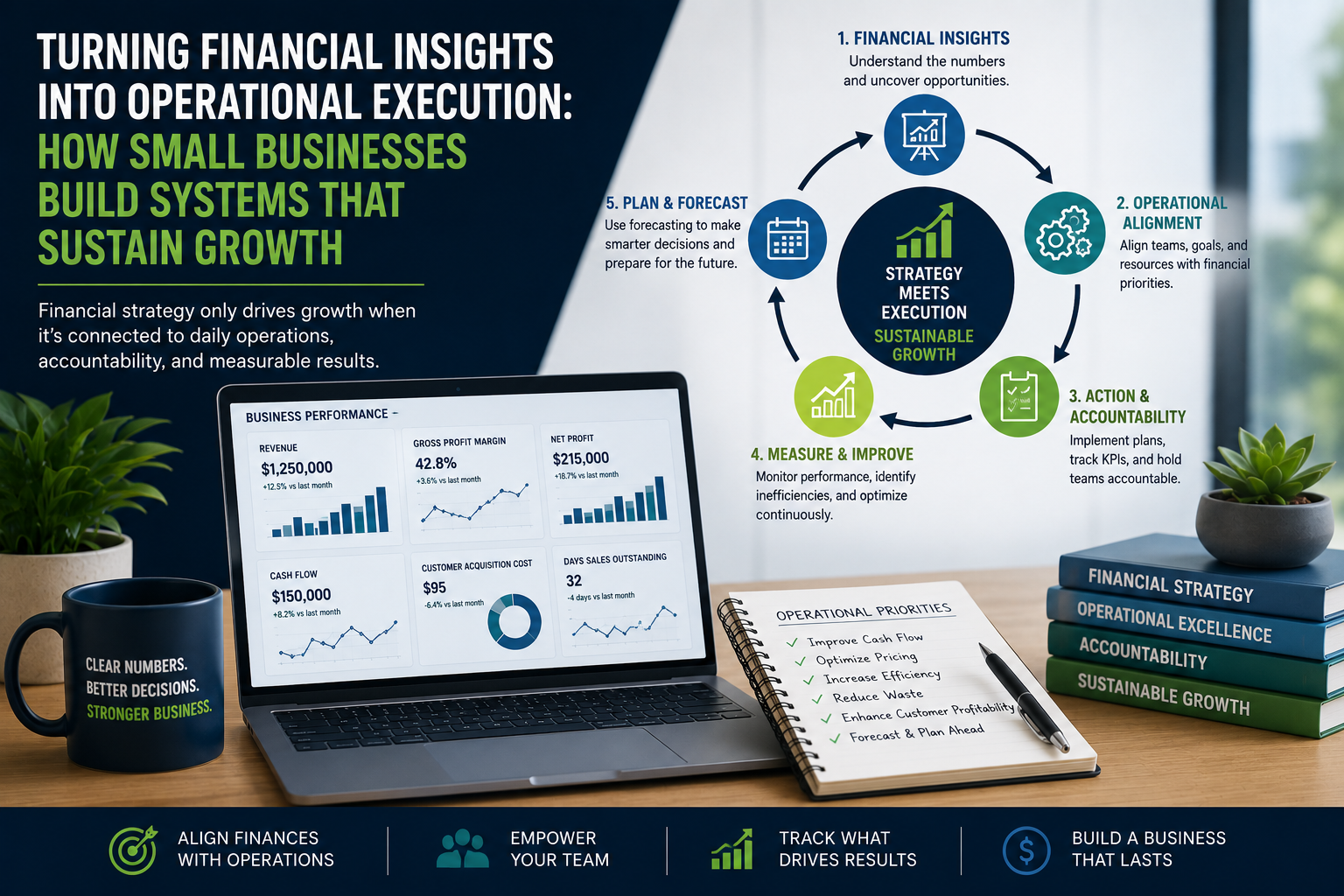

Many small businesses eventually reach a critical stage where financial visibility improves, reports become more organized, and leadership finally begins understanding the numbers behind the business.
But understanding financial reports is only part of the equation.
The next challenge is operational execution.
The article “From Financial Reports to Financial Strategy: How Small Businesses Turn Numbers Into Growth” on Your Accounting Service Blog Posts explains how financial reporting can evolve into strategic financial thinking. However, many growing businesses still struggle with one major issue:
They understand the numbers—but they do not consistently translate those insights into operational systems that improve long-term performance.
This article focuses on the next stage of financial maturity: building operational systems that connect financial strategy directly to daily execution, accountability, and sustainable growth.
Rather than simply reviewing reports after problems occur, successful businesses create financial-operational alignment that allows them to identify issues early, improve efficiency, and scale with greater confidence.
Why Financial Strategy Often Fails in Small Businesses
Many businesses invest heavily in bookkeeping, accounting software, dashboards, and reporting systems.
Yet despite having access to more financial information than ever before, they still experience:
- Cash flow instability
- Margin compression
- Operational bottlenecks
- Hiring inefficiencies
- Decision fatigue
- Uncontrolled overhead growth
- Poor forecasting accuracy
The problem is rarely the absence of data.
The real issue is the absence of operational systems tied directly to financial strategy.
For example:
- Businesses track profitability but fail to monitor labor efficiency
- Companies review revenue but ignore customer acquisition costs
- Leadership monitors cash balances without forecasting future obligations
- Teams focus on sales growth while operational inefficiencies quietly expand
Financial strategy becomes effective only when it changes how the business operates every day.
The Shift From Financial Awareness to Financial Discipline
Many businesses initially experience a breakthrough when they finally gain visibility into their numbers.
They begin reviewing:
- Profit and loss statements
- Balance sheets
- Cash flow reports
- Expense categories
- Revenue trends
This visibility is important—but visibility alone does not improve performance.
Long-term growth requires financial discipline.
Financial discipline means:
- Consistent decision-making
- Operational accountability
- Defined financial benchmarks
- Forecast-driven planning
- Structured resource allocation
- Measurable operational performance
Without discipline, businesses often repeat the same financial mistakes despite having accurate reports.
Financial Systems Should Influence Daily Operations
One of the biggest differences between reactive businesses and scalable businesses is how often financial insights influence operational decisions.
Reactive businesses review reports monthly.
Strategic businesses integrate financial data into daily and weekly operations.
This includes using financial metrics to guide:
Staffing Decisions
Growing businesses frequently hire reactively instead of strategically.
Financial-operational systems help leadership determine:
- When hiring is financially sustainable
- Which departments generate the strongest ROI
- Whether automation may reduce labor costs
- How staffing affects gross margins
Without these systems, payroll often grows faster than profitability.
Pricing Strategy
Many businesses underprice services without realizing how significantly it affects scalability.
Strong financial systems help businesses analyze:
- Gross profit margins
- Service delivery costs
- Labor utilization
- Customer profitability
- Pricing sustainability
This allows companies to make proactive pricing adjustments instead of waiting until profitability declines.
Vendor and Expense Management
Operational expenses tend to increase quietly during growth.
Software subscriptions, contractor costs, marketing tools, and operational inefficiencies slowly compound over time.
Businesses with strong financial systems regularly evaluate:
- Vendor ROI
- Fixed versus variable costs
- Expense efficiency
- Redundant spending
- Operational waste
This prevents overhead from eroding profitability as revenue grows.
The Importance of Financial Accountability Across Teams
One major weakness in many small businesses is that financial responsibility stays isolated within ownership or accounting departments.
Operations teams may never see profitability data.
Sales teams may ignore margin impact.
Marketing teams may focus only on lead volume instead of lead quality.
As businesses scale, this separation creates operational misalignment.
Financial accountability should extend throughout the organization.
For example:
Sales Teams Should Understand:
- Target margins
- Revenue quality
- Payment collection expectations
- Customer profitability
Operations Teams Should Understand:
- Labor efficiency
- Cost control expectations
- Waste reduction goals
- Productivity benchmarks
Marketing Teams Should Understand:
- Customer acquisition cost
- Lead conversion value
- Campaign profitability
- Lifetime customer value
When financial goals become operational goals, execution improves significantly.
Why Operational Efficiency Matters More During Growth
Growth magnifies inefficiencies.
Small operational problems that seem manageable early become major financial liabilities as volume increases.
Examples include:
- Inefficient onboarding systems
- Poor inventory controls
- Delayed invoicing
- Weak collections processes
- Excessive administrative work
- Unclear workflows
- Communication breakdowns
Many businesses attempt to grow revenue before improving operational systems.
This creates a dangerous cycle where increased sales lead to increased stress, declining margins, and worsening cash flow.
Financial strategy should not focus only on increasing revenue.
It should also focus on improving operational efficiency alongside growth.
Building Forecast-Driven Decision Systems
One of the most valuable operational advantages a business can develop is forecast-driven planning.
Too many businesses make decisions based solely on current bank balances or recent revenue performance.
This creates short-term thinking.
Forecast-driven systems allow businesses to anticipate future conditions before they become urgent.
Effective forecasting helps leadership:
- Predict seasonal fluctuations
- Plan hiring timelines
- Prepare for tax obligations
- Manage debt responsibly
- Allocate marketing budgets effectively
- Preserve cash reserves
- Evaluate expansion opportunities
Forecasting creates proactive leadership instead of reactive management.
This concept aligns closely with other financial planning discussions throughout Your Accounting Service Blog Posts focused on forecasting, financial visibility, and strategic growth planning.
Businesses Scale Faster When Decision-Making Becomes Structured
As businesses grow, decision complexity increases rapidly.
Without structured systems, leadership teams often experience:
- Analysis paralysis
- Delayed execution
- Conflicting priorities
- Inconsistent communication
- Reactive problem-solving
Strong financial-operational systems create structure around decision-making.
This includes:
Defining Key Performance Indicators (KPIs)
Businesses should identify the metrics that most directly influence profitability and scalability.
Examples include:
- Gross margin percentage
- Revenue per employee
- Customer acquisition cost
- Days sales outstanding
- Operating expense ratio
- Cash reserve levels
Tracking the right KPIs creates focus.
Establishing Review Cadences
High-performing businesses regularly review:
- Weekly operational performance
- Monthly financial performance
- Quarterly strategic goals
- Annual growth forecasts
Consistency improves organizational alignment.
Creating Action-Oriented Reporting
Reports should not simply summarize history.
They should identify:
- Operational bottlenecks
- Margin risks
- Cash flow threats
- Growth opportunities
- Efficiency improvements
Action-oriented reporting transforms accounting into a strategic growth tool.
Technology Supports Strategy — But Does Not Replace Leadership
Modern accounting platforms and reporting software provide excellent visibility.
However, software alone cannot solve operational or financial problems.
Businesses still require:
- Strategic interpretation
- Leadership accountability
- Operational discipline
- Decision-making frameworks
Technology enhances clarity.
Leadership creates execution.
The most successful businesses combine:
- Accurate bookkeeping
- Reliable reporting
- Operational accountability
- Forecasting systems
- Financial leadership
- Strategic planning
Together, these systems create sustainable scalability.
Sustainable Growth Requires Operational Financial Alignment
Many businesses focus heavily on increasing revenue while overlooking the operational systems required to support that growth.
This eventually creates:
- Employee burnout
- Margin erosion
- Cash shortages
- Operational chaos
- Customer service breakdowns
Sustainable businesses grow differently.
They align:
- Financial strategy
- Operational execution
- Team accountability
- Forecasting systems
- Resource allocation
- Performance measurement
This alignment allows businesses to scale without losing stability.
Final Thoughts
Financial reports are not simply accounting tools.
They are operational guidance systems.
Businesses that use financial information only for tax preparation or historical review often remain reactive.
Businesses that integrate financial insights into operational execution gain a significant competitive advantage.
They:
- Make faster decisions
- Improve profitability
- Strengthen cash flow
- Reduce inefficiencies
- Scale more sustainably
- Build stronger long-term foundations
Financial clarity creates better decisions.
Operational execution turns those decisions into growth.
For additional financial strategy and business growth insights, explore the articles available through Your Accounting Service Blog Posts