
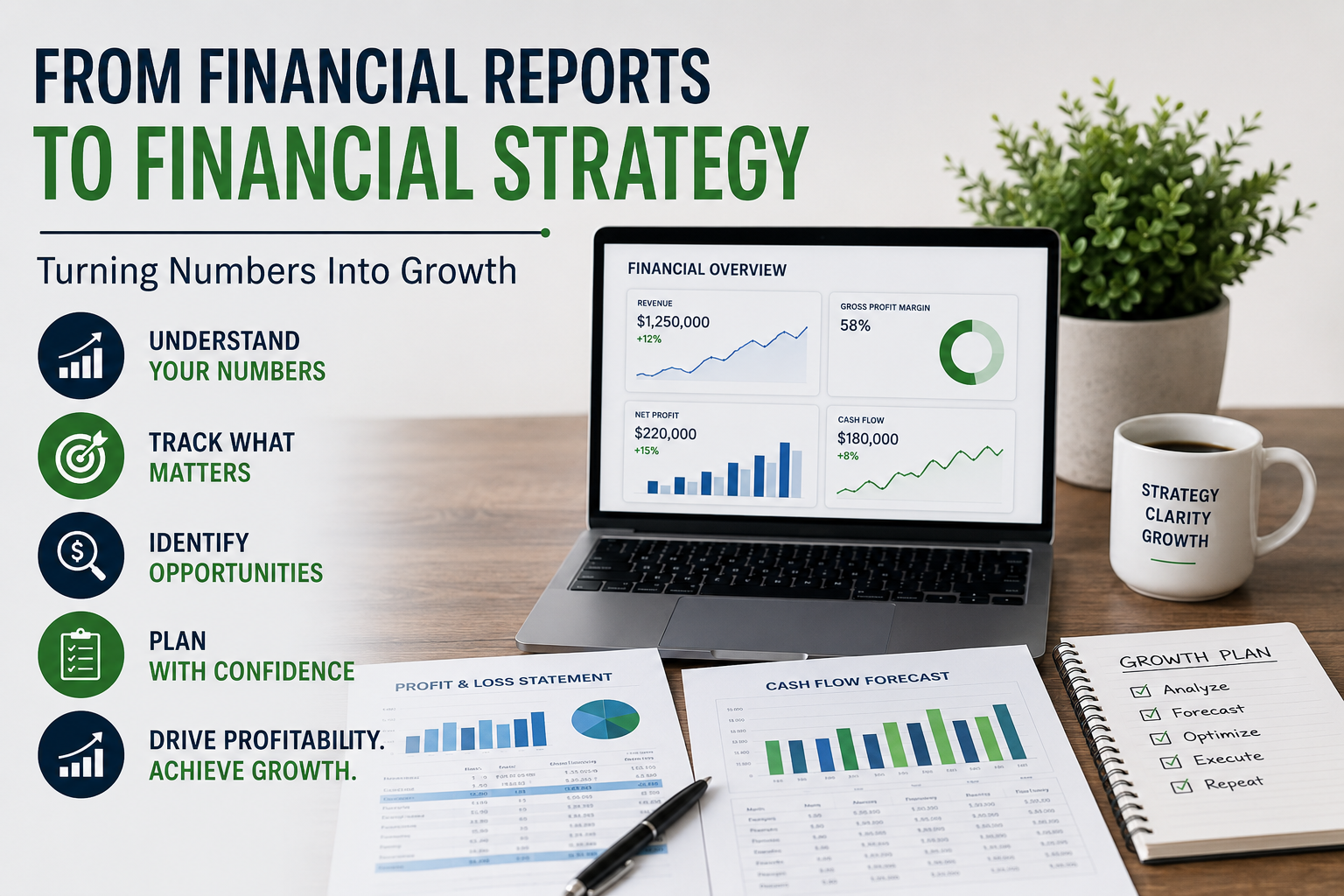

Many small business owners review financial reports every month—but very few use those reports to drive strategic decisions.
Bookkeeping, reconciliations, and financial statements are important, but they are only the starting point. The businesses that grow consistently are the ones that transform financial data into actionable strategy.
This article expands on topics already discussed throughout the Your Accounting Service Blog, including financial systems, bookkeeping structure, cash flow management, forecasting, and KPI tracking. It specifically complements the article “The Financial Systems Every Small Business Needs to Scale Successfully” by focusing on how business owners can actually use their financial information to improve profitability, reduce risk, and make smarter decisions.
Why Financial Reports Alone Are Not Enough
Many businesses generate reports but never truly analyze them.
They may review:
- Profit and loss statements
- Balance sheets
- Cash flow reports
- Bank balances
- Accounts receivable aging
- Expense summaries
But reviewing reports without creating an action plan often leads to:
- Reactive decision-making
- Cash flow surprises
- Missed growth opportunities
- Overspending
- Poor forecasting
- Unclear profitability
Financial reports should act as operational tools—not just compliance documents.
Strong businesses use financial reporting to answer critical questions like:
- Which services are most profitable?
- Where is cash being lost?
- Are expenses growing too quickly?
- Is revenue growth sustainable?
- Which clients or products generate the highest margins?
- When should hiring occur?
- Are pricing adjustments necessary?
- Is the business financially prepared for expansion?
Without strategic analysis, financial reports become historical documents instead of growth tools.
Step 1: Understand the Story Behind the Numbers
Every financial report tells a story.
The key is learning how to interpret it correctly.
Profit and Loss Statement
The profit and loss statement shows whether the business is generating profit over a specific period.
However, many business owners stop at revenue growth.
Revenue alone does not guarantee financial health.
A growing business can still struggle because of:
- Shrinking margins
- Rising operating costs
- Poor pricing
- Excess payroll expenses
- Weak collections
- Uncontrolled overhead
Instead of asking:
“How much revenue did we generate?”
Ask:
“How efficiently did we generate profit?”
Balance Sheet
The balance sheet reveals the overall financial position of the business.
It helps identify:
- Debt levels
- Cash reserves
- Owner equity
- Asset growth
- Financial stability
- Liquidity risks
A strong balance sheet provides flexibility during economic uncertainty.
A weak balance sheet often creates operational stress.
Businesses with poor balance sheet management frequently experience:
- Loan dependency
- Vendor payment issues
- Tax problems
- Limited growth capacity
Statement of Cash Flow
Cash flow is one of the most important indicators of business stability.
As discussed throughout several financial management topics on Your Accounting Service, profitability and cash flow are not the same thing.
A business can show profit on paper while still struggling to pay bills.
Cash flow reporting helps businesses identify:
- Timing issues
- Slow-paying customers
- Seasonal fluctuations
- Payroll pressure
- Debt obligations
- Upcoming cash shortages
Understanding cash flow early allows businesses to make proactive decisions before problems escalate.
Step 2: Use KPIs to Measure Operational Performance
Financial statements provide broad visibility.
KPIs provide precision.
Key Performance Indicators help businesses monitor operational efficiency and financial performance in real time.
Examples include:
| KPI | Why It Matters |
|---|---|
| Gross Profit Margin | Measures profitability efficiency |
| Net Profit Margin | Tracks overall profitability |
| Accounts Receivable Days | Identifies collection issues |
| Current Ratio | Measures short-term liquidity |
| Customer Acquisition Cost | Evaluates marketing efficiency |
| Revenue Per Employee | Measures operational productivity |
| Operating Expense Ratio | Tracks overhead control |
| Cash Reserve Coverage | Measures financial stability |
KPIs turn financial reports into measurable business intelligence.
This aligns closely with existing KPI-focused content already discussed within the site’s accounting and financial management articles.
Step 3: Build Forecasting Into Decision-Making
One of the biggest financial mistakes small businesses make is operating without forecasting.
Many businesses make decisions based only on current bank balances.
But strong financial management requires forward-looking visibility.
Forecasting helps businesses prepare for:
- Seasonal slowdowns
- Hiring decisions
- Equipment purchases
- Tax obligations
- Expansion opportunities
- Cash shortages
- Debt management
- Pricing adjustments
Forecasting transforms financial management from reactive to proactive.
The Power of Scenario Planning
No forecast is perfect.
That is why scenario planning is critical.
Businesses should regularly model:
Base Case
Expected performance under normal conditions.
Best Case
Higher sales growth, stronger margins, or accelerated expansion.
Worst Case
Revenue declines, delayed receivables, rising costs, or economic disruption.
Scenario planning helps leadership teams:
- Establish minimum cash reserve targets
- Identify cost-cutting triggers
- Delay unnecessary spending
- Protect profitability
- Make faster operational decisions
Businesses that prepare for multiple outcomes are far more resilient during uncertainty.
Step 4: Identify Financial Leaks
Many businesses lose profit through operational inefficiencies that go unnoticed.
Common examples include:
- Duplicate subscriptions
- Unprofitable services
- Underpricing
- Payroll inefficiencies
- Excess inventory
- Weak collections
- Delayed invoicing
- High vendor costs
- Unused software tools
Financial reporting helps uncover these hidden issues.
Often, small improvements across multiple areas create substantial profitability gains over time.
Step 5: Connect Financial Data to Daily Operations
Financial management should not exist separately from operations.
The most successful businesses integrate financial visibility into everyday decision-making.
Examples include:
Sales Teams
Monitoring margins instead of only revenue.
Operations Teams
Tracking labor efficiency and operational costs.
Leadership Teams
Reviewing KPI dashboards weekly.
Owners
Using cash flow forecasting before making major decisions.
When financial visibility becomes part of company culture, businesses operate with greater discipline and accountability.
Common Financial Mistakes That Limit Growth
Many small businesses struggle not because they lack revenue—but because they lack structure.
Common issues include:
Delayed Bookkeeping
Late financial data creates poor decisions.
Inconsistent Reporting
Without standardized reporting, trends become difficult to identify.
Mixing Personal and Business Finances
This creates accounting confusion and inaccurate reporting.
Relying Only on Bank Balances
Bank balances do not reflect:
- Tax obligations
- Profitability
- Accounts payable
- Upcoming liabilities
- Future cash needs
Ignoring Financial Trends
Most financial problems begin gradually.
Early warning signs often include:
- Shrinking margins
- Slower collections
- Rising expenses
- Declining reserves
- Increasing debt
Consistent reporting and forecasting help identify issues before they become crises.
How Financial Visibility Creates Better Businesses
Businesses with strong financial visibility often experience:
Faster Decision-Making
Leaders operate with confidence because decisions are based on data.
Improved Profitability
Clear reporting reveals waste and opportunities.
Better Cash Flow Stability
Forecasting reduces surprises.
Reduced Stress
Organized systems eliminate financial chaos.
Easier Scaling
Growth becomes manageable because processes already exist.
Stronger Business Value
Well-managed financial systems improve credibility with:
- Investors
- Lenders
- Buyers
- Strategic partners
This directly aligns with the financial systems and operational structure principles discussed in existing content on Your Accounting Service.
Final Thoughts
Financial reports should do more than explain the past.
They should help shape the future of the business.
When bookkeeping, reporting, KPI tracking, forecasting, and operational planning work together, business owners gain the visibility needed to grow strategically and sustainably.
Strong financial management is not just about compliance.
It is about clarity.
It is about control.
And ultimately, it is about building a business that can scale with confidence.
For businesses looking to improve bookkeeping systems, reporting accuracy, cash flow visibility, and strategic financial management, Your Accounting Service provides financial support solutions designed to help small businesses operate more efficiently and grow with stronger financial direction.