
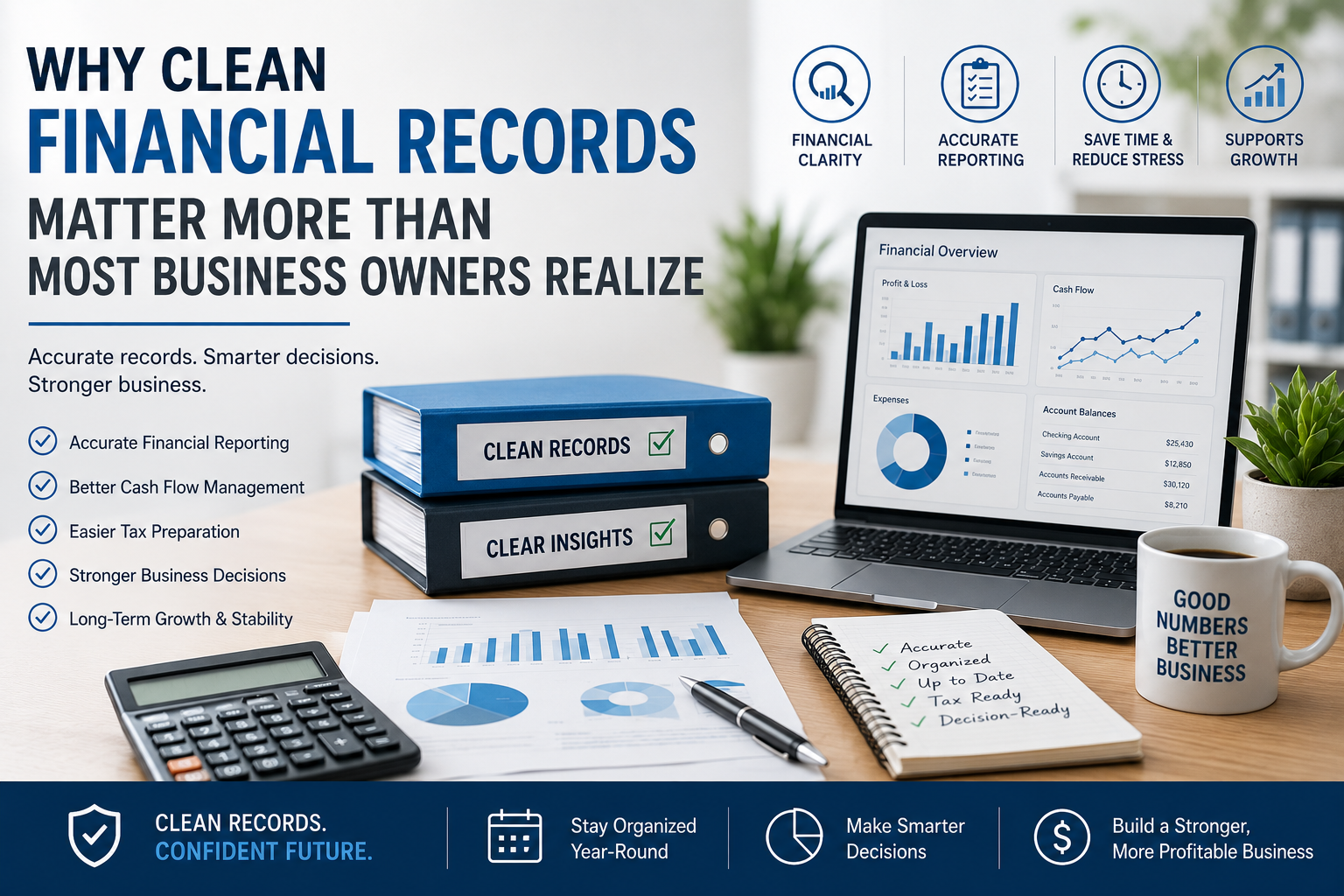

Many business owners focus heavily on sales, marketing, and operations—but overlook one of the most important foundations of long-term success:
Clean and organized financial records.
At first glance, bookkeeping and accounting may seem like purely administrative tasks. But in reality, the quality of your financial records directly impacts:
- Cash flow
- Tax accuracy
- Profitability
- Decision-making
- Business growth
- Financing opportunities
- Stress levels
- Operational efficiency
Disorganized books create confusion. Clean books create clarity.
At Your Accounting Service, we help businesses build reliable financial systems that support smarter decisions, stronger operations, and sustainable growth.
What Are “Clean Financial Records”?
Clean financial records mean your accounting data is:
- Accurate
- Up to date
- Properly categorized
- Reconciled consistently
- Easy to understand
- Organized for reporting and tax purposes
This includes maintaining accurate:
- Profit & Loss statements
- Balance sheets
- Cash flow reports
- Bank reconciliations
- Accounts payable
- Accounts receivable
- Payroll records
- Expense tracking
- Tax documentation
When your records are organized properly, your business operates with significantly more confidence and control.
The Hidden Problems Caused by Poor Financial Organization
Many businesses operate for months—or even years—with bookkeeping issues they don’t fully recognize.
Unfortunately, small accounting problems often grow into major financial headaches over time.
1. Cash Flow Problems Become Harder to Identify
If financial records are inaccurate, business owners struggle to understand:
- How much cash is actually available
- Which expenses are increasing
- Which customers owe money
- Whether the business is truly profitable
This often leads to surprise shortages and unnecessary financial stress.
Without reliable data, planning becomes nearly impossible.
2. Tax Season Becomes Overwhelming
Poor bookkeeping creates major complications during tax preparation.
Common problems include:
- Missing expense documentation
- Misclassified transactions
- Incomplete reconciliations
- Incorrect payroll reporting
- Untracked deductions
This can result in:
- Filing delays
- Increased accounting costs
- Tax penalties
- IRS notices
- Overpaying taxes
Clean books throughout the year make tax season dramatically easier and less stressful.
3. Financial Reports Become Unreliable
Financial reports are only useful if the underlying data is accurate.
If bookkeeping is inconsistent, reports may:
- Overstate profits
- Underestimate expenses
- Misrepresent liabilities
- Hide cash flow issues
- Distort operational performance
Business decisions based on inaccurate reporting can create serious long-term consequences.
4. Business Growth Becomes More Difficult
Growth requires visibility.
When accounting systems are disorganized, businesses struggle to:
- Forecast accurately
- Secure financing
- Manage hiring
- Control expenses
- Measure profitability
- Plan expansion
Lenders and investors also expect professional financial reporting before providing capital.
Clean records improve credibility and financial confidence.
Why Accurate Bookkeeping Is More Than Data Entry
Many people think bookkeeping simply involves entering transactions into accounting software.
In reality, effective bookkeeping supports the entire financial health of a business.
Professional bookkeeping helps businesses:
- Track profitability
- Monitor trends
- Improve budgeting
- Reduce errors
- Strengthen compliance
- Improve cash flow management
- Prepare for audits
- Support strategic planning
Good bookkeeping creates the financial foundation needed for informed decision-making.
Common Bookkeeping Mistakes Small Businesses Make
Small businesses often experience similar accounting problems.
Recognizing these early can prevent significant issues later.
Mixing Personal and Business Expenses
This is one of the most common bookkeeping mistakes.
It creates:
- Confusing records
- Tax complications
- Inaccurate profitability reporting
- Increased audit risk
Maintaining separate accounts is essential for clean financial management.
Falling Behind on Reconciliations
Bank and credit card reconciliations ensure transactions match actual account activity.
Without regular reconciliations:
- Errors go unnoticed
- Duplicate transactions occur
- Fraud becomes harder to detect
- Financial reports become inaccurate
Consistent monthly reconciliations are critical.
Improper Expense Categorization
Incorrect categorization distorts reporting and can impact taxes.
For example:
- Equipment purchases
- Contractor payments
- Marketing expenses
- Owner distributions
- Loan payments
All require proper classification to maintain accurate records.
Waiting Until Tax Season
Trying to organize an entire year of bookkeeping at once creates unnecessary stress and errors.
Consistent bookkeeping throughout the year allows businesses to:
- Stay organized
- Monitor performance
- Make timely decisions
- Avoid year-end panic
How Professional Accounting Services Improve Business Operations
Outsourcing bookkeeping and accounting provides more than convenience.
It creates operational efficiency.
1. Saves Time
Business owners should focus on:
- Revenue generation
- Customer relationships
- Growth initiatives
- Operational leadership
Not spending hours trying to reconcile transactions or troubleshoot accounting software.
Professional accounting support frees up valuable time.
2. Reduces Stress
Financial uncertainty creates anxiety for many business owners.
Accurate financial systems reduce stress by creating:
- Reliable reporting
- Better visibility
- Organized documentation
- Consistent processes
When business owners trust their numbers, decision-making becomes easier.
3. Improves Financial Visibility
Professional accounting services provide clear insights into:
- Revenue trends
- Expense patterns
- Profit margins
- Cash flow
- Financial risks
This helps businesses identify problems early and act proactively.
4. Supports Better Decision-Making
Every major business decision has a financial impact.
Whether considering:
- Hiring
- Pricing adjustments
- Equipment purchases
- Expansion
- Marketing investments
Reliable financial reporting helps leadership evaluate risk and opportunity with greater confidence.
The Role of Technology in Modern Accounting
Cloud-based accounting software has transformed financial management for small businesses.
Tools like:
- QuickBooks Online
- Xero
- FreshBooks
- Zoho Books
Allow businesses to:
- Access real-time financial data
- Automate reporting
- Track expenses digitally
- Improve collaboration
- Simplify invoicing and payments
However, software alone is not enough.
Proper setup, organization, and oversight remain essential for accurate financial management.
Signs Your Business May Need Professional Accounting Help
You may benefit from accounting support if:
- Your books are behind
- Financial reports feel confusing
- Tax season is stressful
- Cash flow feels unpredictable
- You’re unsure if the business is truly profitable
- Reconciling accounts takes too much time
- You’ve received tax notices or penalties
- Growth is becoming difficult to manage
The earlier financial issues are addressed, the easier they are to fix.
How Your Accounting Service Helps Businesses Stay Organized
At Your Accounting Service, we help businesses simplify their financial operations through organized, reliable, and professional accounting support.
Our goal is to help clients:
- Maintain accurate books
- Improve financial clarity
- Reduce accounting stress
- Make informed decisions
- Stay compliant year-round
Whether your business needs monthly bookkeeping, cleanup services, reconciliations, or ongoing financial organization, having dependable financial systems creates a stronger foundation for long-term success.
Final Thoughts
Financial organization is not just an accounting task—it is a business strategy.
Clean books improve visibility, reduce risk, strengthen decision-making, and support growth.
Businesses that prioritize financial organization position themselves to operate more efficiently, respond more confidently, and scale more sustainably.
Because when your financial records are clear, your business decisions become clearer too.