
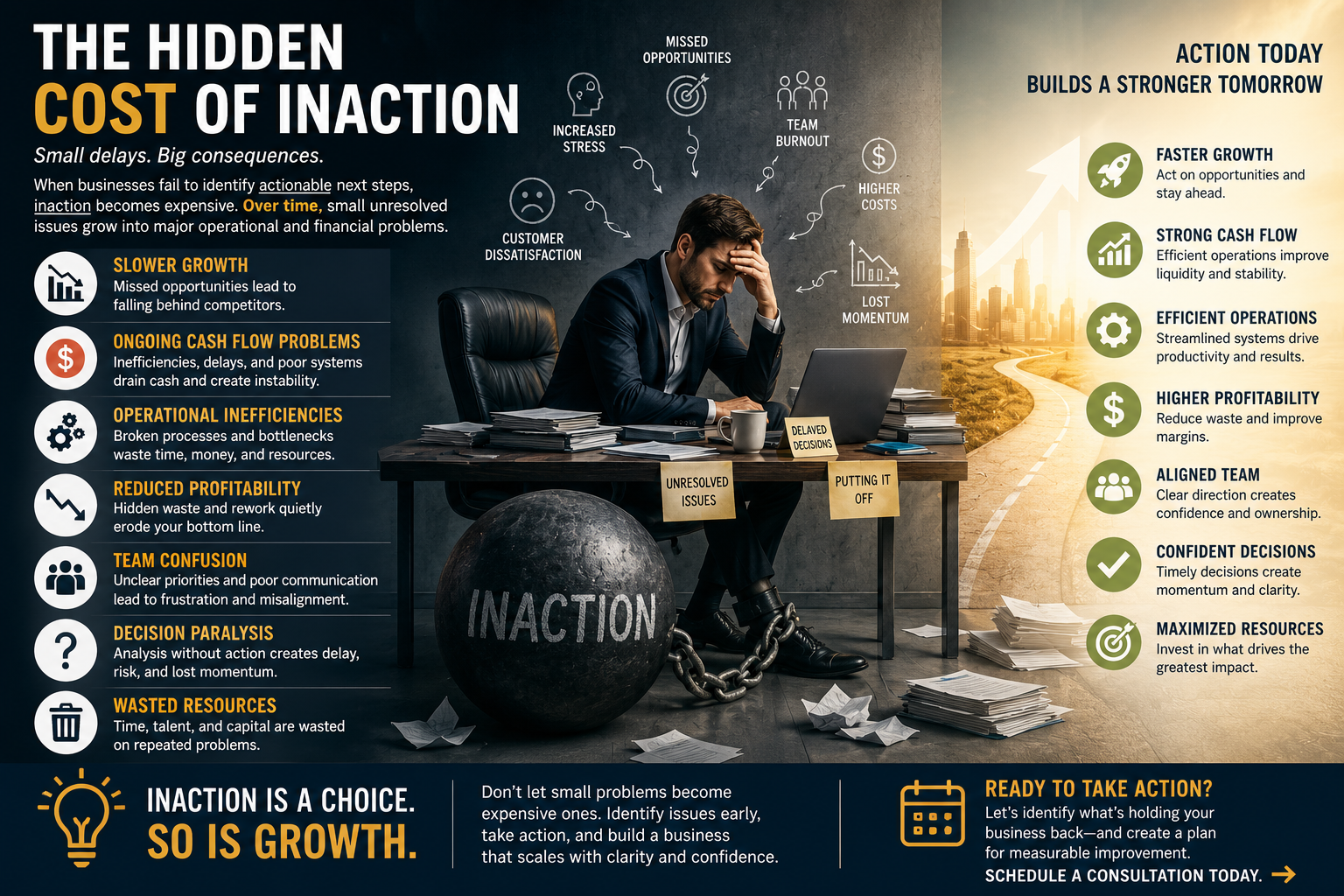

Most business problems do not become catastrophic overnight.
Instead, they grow quietly in the background — hidden inside delayed decisions, unresolved operational issues, poor systems, and postponed improvements. What begins as a “small issue” eventually compounds into lost profit, team frustration, operational chaos, and stalled growth.
Many businesses assume that maintaining the status quo is the safest option. In reality, inaction is often one of the most expensive decisions a company can make. Studies and operational research consistently show that inefficiencies, delays, and unresolved process problems quietly consume profitability and reduce long-term business performance.
The danger is that the cost of inaction rarely appears all at once. It accumulates slowly over time until the effects become impossible to ignore.
What Is Business Inaction?
Business inaction occurs when organizations recognize problems or opportunities but fail to take meaningful action.
This often looks like:
- Delaying operational improvements
- Avoiding difficult decisions
- Postponing system upgrades
- Ignoring recurring inefficiencies
- Failing to define actionable next steps
- Remaining stuck in analysis without execution
At first, these delays may seem harmless. But over time, unresolved issues begin affecting nearly every part of the business.
The longer problems remain unaddressed, the more expensive they become.
Why Inaction Is So Dangerous
Inaction creates a false sense of stability.
Because the business is still functioning, leadership assumes things are “good enough.” But operational friction continues building beneath the surface:
- Teams become reactive
- Processes become inefficient
- Decision-making slows
- Margins tighten
- Employees become overwhelmed
- Customers experience inconsistency
Research on operational inefficiency shows that hidden waste and unresolved process issues can consume a significant percentage of revenue over time.
The problem is rarely one massive failure.
It is usually the accumulation of hundreds of small unresolved problems.
1. Slower Business Growth
One of the first consequences of inaction is stalled growth.
Businesses that fail to identify and execute actionable next steps often become trapped in maintenance mode instead of growth mode.
This happens because:
- Leadership spends too much time reacting
- Operational bottlenecks slow execution
- Opportunities are missed
- Teams lack direction
- Strategic initiatives never fully launch
Growth requires momentum. Momentum requires execution.
Businesses that consistently delay decisions eventually fall behind competitors that move faster and adapt more effectively.
What This Looks Like:
- Growth plateaus despite market opportunity
- Strategic projects remain unfinished
- Competitors innovate faster
- Leadership discussions produce little execution
Hidden Cost:
Lost market share and reduced scalability
2. Ongoing Cash Flow Problems
Cash flow issues are often treated purely as financial problems, but operational inefficiency frequently plays a major role.
When businesses fail to take corrective action:
- Invoicing delays continue
- Rework consumes labor hours
- Excess inventory ties up cash
- Approval bottlenecks slow revenue
- Inefficient workflows increase operating costs
Over time, operational inefficiency quietly drains working capital.
Many businesses focus on increasing revenue without addressing the systems that are consuming profit behind the scenes.
Common Signs:
- Revenue grows but cash remains tight
- Constant financial stress despite sales activity
- Delayed collections
- Increasing operational expenses
Hidden Cost:
Reduced financial stability and lower profitability
3. Operational Inefficiencies Continue to Compound
Operational inefficiency rarely stays isolated.
One unresolved issue often creates several additional problems:
- Poor communication creates delays
- Delays create rushed work
- Rushed work creates mistakes
- Mistakes create rework
- Rework consumes time and resources
This cycle compounds over time.
Research on operational performance consistently shows that fragmented systems, manual workarounds, and poor process visibility reduce productivity and increase operational cost.
The most dangerous part is that many organizations normalize inefficiency.
Chaos becomes “how things work.”
What This Looks Like:
- Repeated mistakes
- Constant bottlenecks
- Manual workarounds
- Excessive meetings
- Frequent confusion
- Endless firefighting
Hidden Cost:
Lower productivity and operational drag
4. Reduced Profitability
Many businesses assume shrinking margins are caused by pricing pressure or market conditions alone.
In reality, unresolved operational problems often quietly destroy profitability.
Operational waste appears in many forms:
- Duplicate work
- Miscommunication
- Delays
- Inefficient labor allocation
- Underutilized systems
- Poor process design
- Lack of accountability
When inefficiency compounds, businesses spend more money delivering the same output.
This creates a dangerous cycle:
- Revenue must increase simply to maintain current margins
- Teams work harder without meaningful financial improvement
- Leadership struggles to identify the true source of declining profitability
Hidden Cost:
A lower profitability ceiling
5. Team Confusion and Misalignment
When businesses fail to define actionable next steps, teams lose clarity.
Employees begin operating reactively because:
- Priorities constantly shift
- Expectations are unclear
- Ownership is undefined
- Processes are undocumented
- Communication lacks structure
Confused teams move slower and make more mistakes.
Worse, uncertainty damages morale. Employees become frustrated when they spend more time navigating chaos than producing meaningful results.
Common Symptoms:
- Employees repeatedly asking the same questions
- Constant clarification requests
- Lack of accountability
- Misaligned priorities
- Departments operating independently instead of collaboratively
Hidden Cost:
Lower morale and weaker execution
6. Decision Paralysis
One of the most overlooked consequences of inaction is the development of decision paralysis.
Businesses become trapped in endless:
- Meetings
- Discussions
- Analysis
- Planning sessions
- Delayed approvals
The organization becomes increasingly cautious and reactive.
This is particularly dangerous in competitive markets where speed and adaptability matter.
Companies that delay important operational improvements often lose the ability to respond quickly to changing conditions.
What Decision Paralysis Looks Like:
- Constant overanalysis
- Slow approvals
- Delayed implementation
- Fear of making imperfect decisions
- Excessive dependence on leadership approval
Hidden Cost:
Lost agility and missed opportunities
7. Wasted Resources
Every unresolved operational issue consumes resources:
- Time
- Labor
- Energy
- Attention
- Capital
The longer inefficiencies remain unresolved, the more waste accumulates.
This includes:
- Employees performing unnecessary manual work
- Repeated problem-solving for recurring issues
- Excessive software and tools
- Duplicate communication
- Overstaffing to compensate for poor systems
Many businesses attempt to solve operational inefficiency by simply adding more people or more tools.
But complexity without structure usually creates even more inefficiency.
Hidden Cost:
Lower return on operational investment
The Compounding Effect of Inaction
The most important thing to understand about inaction is this:
Its cost compounds.
A small unresolved issue today may become:
- A customer retention issue next year
- A profitability problem the year after
- A scalability crisis later on
Operational friction builds gradually until it begins limiting:
- Growth
- Cash flow
- Team performance
- Leadership effectiveness
- Business value
By the time many organizations recognize the damage, reversing it becomes far more expensive.
As operational experts frequently note, inefficiencies do not remain static — they intensify over time when left unresolved.
Why Businesses Avoid Taking Action
Despite the risks, many organizations delay operational improvements because:
- They are too busy reacting
- Problems feel manageable “for now”
- Leadership fears disruption
- Systems seem too complex to fix
- There is no clear ownership of improvement initiatives
Ironically, the businesses that most need operational improvement are often the businesses least able to pause long enough to address it.
What High-Performing Businesses Do Differently
Operationally strong businesses understand that action creates momentum.
Instead of waiting for problems to become severe, they:
- Identify inefficiencies early
- Build scalable systems
- Clarify ownership and accountability
- Improve workflows continuously
- Prioritize operational visibility
- Turn insights into measurable action
Most importantly, they understand that operational improvement is not just about efficiency.
It is about:
- Profitability
- Scalability
- Leadership leverage
- Team performance
- Sustainable growth
How to Break the Cycle of Inaction
The first step is visibility.
Businesses cannot improve what they have not clearly identified.
Start by evaluating:
- Where delays repeatedly occur
- Which processes create the most frustration
- Where profitability is leaking
- Which operational problems recur most often
- What decisions are constantly postponed
- Where leadership spends excessive time firefighting
From there, focus on high-impact operational improvements instead of trying to fix everything at once.
Small operational improvements, implemented consistently, create compounding returns over time.
Final Thoughts
Inaction feels safe in the short term.
But over time, it becomes one of the most expensive operational decisions a business can make.
Small unresolved issues eventually grow into:
- Operational inefficiency
- Financial pressure
- Team burnout
- Slower growth
- Leadership overwhelm
- Reduced business value
The businesses that scale most successfully are not the ones that avoid problems entirely.
They are the ones that identify problems early, make decisions quickly, and consistently turn insight into action.
Because in business, the cost of doing nothing is rarely nothing at all.