
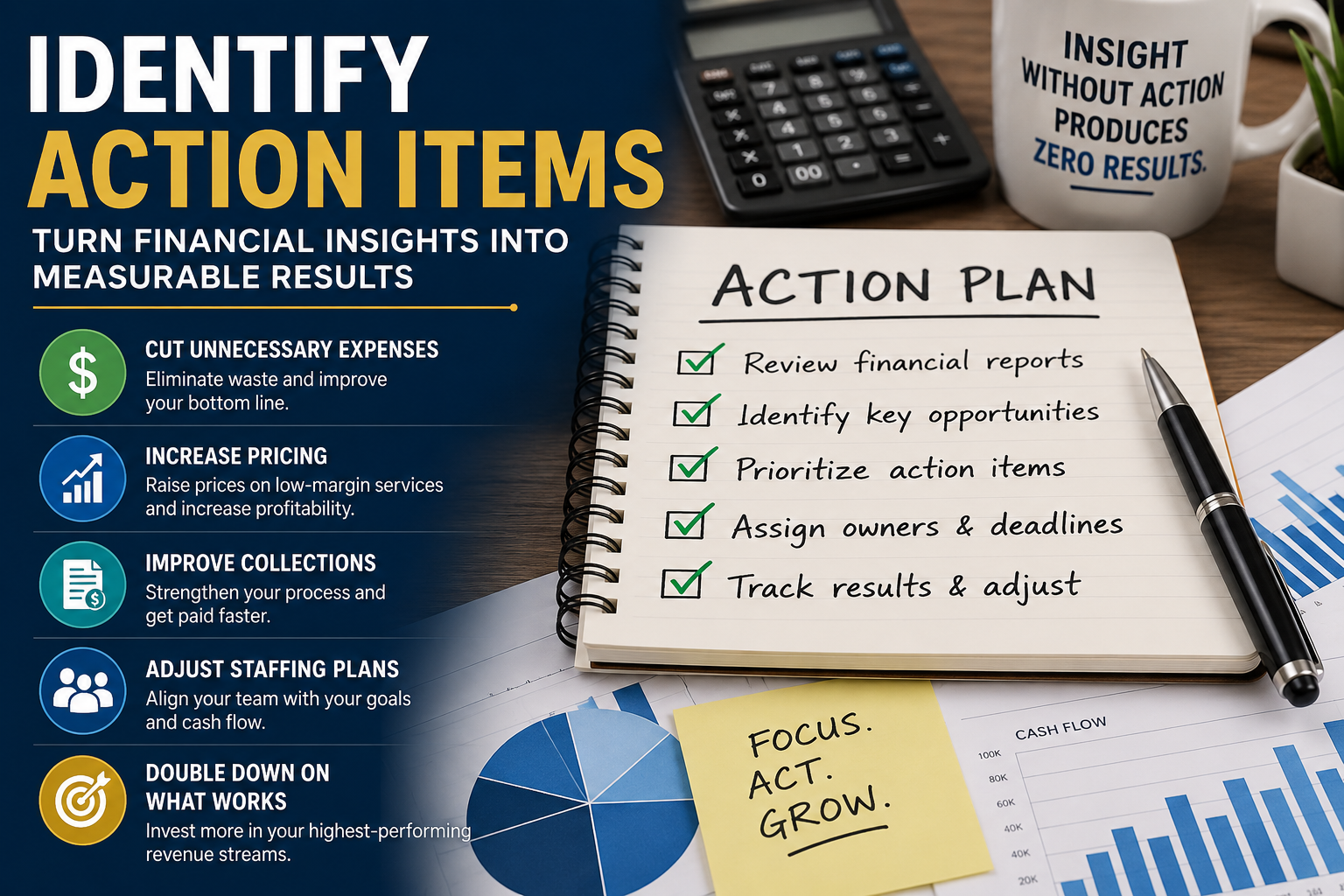

Every business owner wants better results. Better cash flow. Better profitability. Better growth. Yet many businesses spend hours reviewing reports, tracking metrics, and discussing problems—without ever taking meaningful action.
That’s where most businesses get stuck.
They gather information but fail to convert it into decisions.
And without action, even the best financial insights are worthless.
At its core, business success is not determined by how much information you collect—it’s determined by how effectively you act on that information.
The businesses that consistently grow are not necessarily the smartest or the most sophisticated. They are the businesses that identify clear action items, execute quickly, and continuously improve.
Why Identifying Action Items Matters
Financial reports, KPIs, market analysis, and operational reviews are valuable tools—but they are only useful if they lead to measurable action.
Too often, businesses:
- Review profit and loss statements without adjusting spending
- Analyze cash flow problems without improving collections
- Notice declining margins without adjusting pricing
- Discuss inefficiencies without changing systems
- Hold meetings that end without accountability
The result?
Nothing changes.
The Hidden Cost of Inaction
When businesses fail to identify actionable next steps, they experience:
- Slower growth
- Ongoing cash flow problems
- Operational inefficiencies
- Reduced profitability
- Team confusion
- Decision paralysis
- Wasted resources
Over time, inaction becomes expensive.
Small unresolved issues eventually become major operational and financial problems.
Insight Without Action Produces Zero Results
This is one of the most important principles in business management.
You can have:
- Great accounting software
- Detailed dashboards
- Weekly reports
- Financial forecasts
- KPI tracking systems
But if leadership never acts on the information, none of it matters.
Data alone does not improve a business.
Execution does.
The goal of financial analysis is not simply to understand your business—it’s to improve it.
That requires identifying specific, measurable, actionable decisions.
How to Identify Effective Action Items
Strong action items are:
✅ Specific
✅ Measurable
✅ Realistic
✅ Prioritized
✅ Assigned to someone
✅ Tied to business goals
Weak action items sound like:
- “We need to do better.”
- “Sales should improve.”
- “We should reduce expenses.”
Strong action items sound like:
- “Cancel underused software subscriptions by Friday.”
- “Increase prices on Service Package A by 8% next month.”
- “Reduce accounts receivable over 60 days by 25%.”
- “Hire one technician instead of three until revenue stabilizes.”
Clear actions create measurable progress.
Examples of High-Impact Business Action Items
1. Cut Unnecessary Subscriptions or Expenses
One of the fastest ways to improve profitability is reducing waste.
Many businesses accumulate:
- Unused software subscriptions
- Duplicate tools
- Excess vendor services
- Unnecessary memberships
- Overspending on low-value activities
Over time, these costs quietly erode profit margins.
Action Steps:
- Review recurring monthly expenses
- Identify tools no longer being used
- Eliminate duplicate software platforms
- Renegotiate vendor contracts
- Cancel low-ROI services
Example:
A company discovers:
- 4 unused software subscriptions
- Duplicate project management tools
- Overlapping marketing platforms
Total savings:
$1,200 per month.
That equals:
$14,400 annually in recovered cash flow.
Small operational decisions often create major financial improvements.
2. Increase Pricing on Low-Margin Services
Many businesses underprice their services.
This is especially common among:
- Contractors
- Consultants
- Bookkeepers
- Service businesses
- Freelancers
Inflation, rising labor costs, and operational expenses slowly reduce margins over time.
Yet many businesses avoid price increases out of fear.
The problem?
Low-margin services consume time, energy, and labor while generating minimal profit.
How to Identify Underpriced Services
Review:
- Gross profit margins
- Labor costs
- Time requirements
- Customer profitability
- Service delivery costs
Action Steps:
- Raise pricing on low-margin offerings
- Eliminate unprofitable services
- Create premium service tiers
- Introduce minimum project fees
- Bundle services strategically
Example:
A business increases pricing by:
- 7% on legacy service packages
- 12% on custom projects
Customer retention remains stable.
Annual profit increases significantly without increasing workload.
Sometimes the fastest way to grow revenue is charging appropriately for the value you already provide.
3. Improve the Collections Process
Cash flow problems are often collections problems.
Many businesses complete work successfully—but struggle to get paid quickly.
Late payments create:
- Cash shortages
- Payroll pressure
- Delayed investments
- Increased stress
- Dependence on credit lines
Improving collections can dramatically strengthen cash flow.
Common Collection Problems
- Invoices sent late
- Unclear payment terms
- No follow-up process
- Limited payment options
- Weak overdue enforcement
Action Steps:
- Send invoices immediately
- Shorten payment terms
- Require deposits upfront
- Automate reminders
- Accept ACH and online payments
- Follow up consistently on overdue accounts
Example Collection Timeline:
- Reminder 3 days before due date
- Reminder on due date
- Follow-up at 3 days overdue
- Additional notices at 7 and 14 days overdue
Consistent follow-up improves cash flow dramatically.
4. Adjust Hiring or Staffing Plans
Many businesses either:
- Hire too aggressively
- Wait too long to hire
- Staff inefficiently
Labor is often one of the largest business expenses.
Poor staffing decisions can quickly damage profitability.
Signs Staffing Needs Adjustment
Overstaffed:
- Declining productivity
- Idle labor
- Shrinking margins
- Payroll strain
Understaffed:
- Burnout
- Delayed projects
- Customer dissatisfaction
- Missed revenue opportunities
Action Steps:
- Delay unnecessary hires
- Cross-train existing staff
- Use contractors strategically
- Improve scheduling efficiency
- Align staffing with revenue forecasts
Example:
Instead of hiring:
- 3 full-time employees immediately
A business:
- Hires 1 employee
- Uses contractors temporarily
- Reassesses in 90 days
Result:
- Preserved cash flow
- Reduced payroll risk
- Maintained operational flexibility
Smart staffing protects both growth and profitability.
5. Double Down on High-Performing Revenue Streams
Not all revenue is equally valuable.
Some products or services:
- Generate higher margins
- Require less support
- Scale more easily
- Produce repeat business
- Attract better clients
High-performing businesses identify what works—and invest more heavily in it.
Questions to Ask:
- Which services produce the highest margins?
- Which customers are most profitable?
- Which marketing channels generate the best ROI?
- Which offerings scale efficiently?
Action Steps:
- Increase marketing for top-performing services
- Expand successful offerings
- Eliminate low-performing products
- Focus sales efforts strategically
- Build systems around profitable operations
Example:
A consulting firm discovers:
- 70% of profit comes from CFO advisory services
- Only 20% comes from basic bookkeeping
The company:
- Expands advisory offerings
- Raises bookkeeping minimums
- Markets higher-value services more aggressively
Result:
- Higher profitability
- Better scalability
- Improved client quality
Growth becomes easier when you focus on what already works.
Turn Financial Reports Into Action Plans
Financial statements should guide decisions.
Profit & Loss Statement
Use it to identify:
- Expense reduction opportunities
- Margin issues
- Revenue trends
- Cost increases
Balance Sheet
Use it to evaluate:
- Debt levels
- Liquidity
- Asset utilization
- Financial stability
Statement of Cash Flow
Use it to monitor:
- Cash shortages
- Spending patterns
- Operational efficiency
- Financing needs
The purpose of reporting is not just visibility—it’s strategic action.
Create Accountability Around Action Items
Even strong ideas fail without accountability.
Every action item should include:
| Component | Example |
|---|---|
| Action | Reduce software expenses |
| Owner | Operations Manager |
| Deadline | June 1 |
| Goal | Save $500/month |
| Measurement | Monthly expense reduction |
Without ownership, action items often disappear after meetings.
Accountability drives execution.
Prioritize High-Impact Actions First
Not all action items are equally important.
Focus first on:
- Cash flow improvements
- Margin expansion
- Revenue growth opportunities
- Operational bottlenecks
- High-cost inefficiencies
Avoid getting distracted by low-impact tasks.
The goal is strategic improvement—not simply staying busy.
Build a Culture of Action
Businesses that succeed long term create operational discipline around execution.
That means:
- Reviewing performance regularly
- Making decisions quickly
- Adjusting strategies proactively
- Holding teams accountable
- Measuring results consistently
Execution should become part of company culture.
Because businesses rarely fail from lack of information.
They fail from lack of action.
Final Thoughts
Identifying action items is one of the most important business disciplines—and one of the most overlooked.
Data alone does not improve performance.
Reports alone do not increase profitability.
Meetings alone do not solve problems.
Action does.
The businesses that grow consistently are the ones that:
- Identify problems quickly
- Make decisions confidently
- Execute strategically
- Adapt continuously
Remember:
👉 Insight without action produces zero results.
The goal is not simply to understand your business better.
The goal is to improve it.