
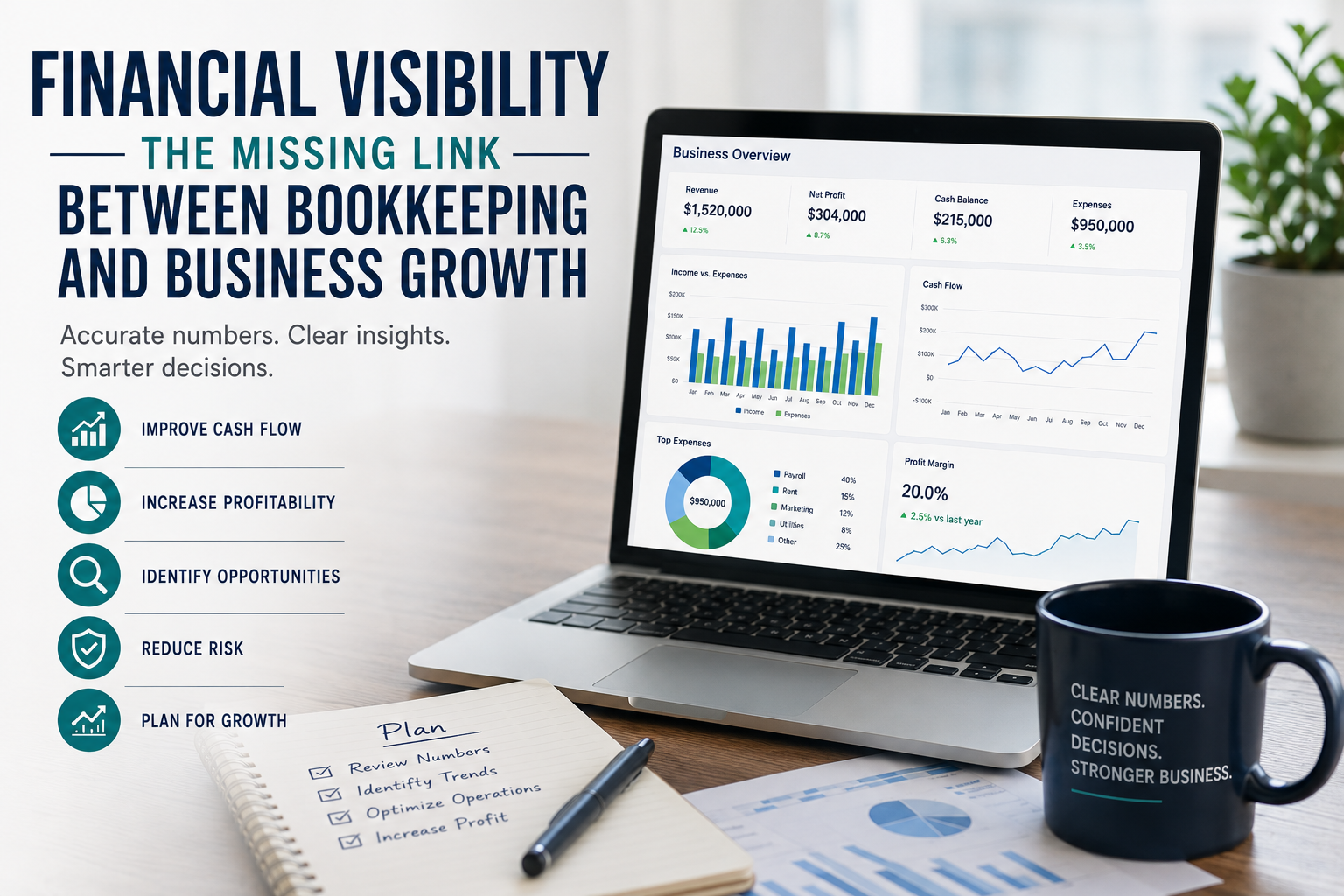

Many business owners believe bookkeeping is simply about staying organized for tax season. In reality, your financial records are one of the most powerful tools for making strategic business decisions, improving profitability, and creating sustainable growth.
At Your Accounting Service, we often see small businesses struggle not because they lack customers or opportunity—but because they lack clear financial visibility. Without accurate, timely financial data, even strong businesses can unknowingly make decisions that hurt cash flow, reduce profitability, and limit growth potential.
This article complements many of the existing topics already published on your site—including KPIs, financial reviews, cash flow management, budgeting, and operational efficiency—by focusing on the critical connection between organized financial records and confident business decision-making.
What Is Financial Visibility?
Financial visibility means having a clear, accurate, and real-time understanding of your business finances.
This includes:
- Revenue trends
- Profit margins
- Cash flow movement
- Outstanding invoices
- Expenses and overhead
- Debt obligations
- Inventory costs
- Payroll obligations
- Tax liabilities
- Financial forecasts
When business owners lack visibility, they operate reactively instead of proactively.
They often discover problems too late:
- Cash shortages
- Declining profitability
- Overspending
- Tax surprises
- Unprofitable services
- Operational inefficiencies
Strong bookkeeping creates the foundation for financial visibility.
Why Financial Visibility Matters
1. Better Decision-Making
Every business decision has financial consequences.
Examples include:
- Hiring employees
- Expanding locations
- Increasing marketing spend
- Purchasing equipment
- Raising prices
- Taking on debt
- Launching new services
Without reliable financial data, these decisions become guesses instead of informed strategies.
Business owners with strong financial visibility can:
- Analyze trends
- Identify risks early
- Allocate resources effectively
- Predict future cash needs
- Measure profitability accurately
Data-driven businesses consistently outperform businesses operating on assumptions.
2. Improved Cash Flow Management
Profit and cash flow are not the same thing.
A business may show a profit on paper while still struggling to pay bills.
Financial visibility helps businesses monitor:
- Accounts receivable
- Vendor obligations
- Payroll timing
- Seasonal fluctuations
- Debt payments
- Inventory purchases
With accurate bookkeeping and regular reporting, businesses can identify cash flow issues before they become emergencies.
This allows owners to:
- Adjust spending
- Improve collections
- Delay unnecessary purchases
- Build cash reserves
- Plan for slower seasons
Poor cash flow management remains one of the leading causes of small business failure.
3. Identifying Your Most Profitable Activities
Not all revenue is good revenue.
Many businesses generate high sales volume while producing very little actual profit.
Financial visibility helps uncover:
- Which products are most profitable
- Which services lose money
- Which clients require excessive support
- Which departments overspend
- Which marketing channels deliver ROI
This insight allows businesses to focus on high-performing areas instead of spreading resources too thin.
One of the biggest growth mistakes businesses make is scaling inefficient operations.
4. Faster Response to Problems
Businesses rarely fail overnight.
Most financial problems develop slowly:
- Declining margins
- Increasing expenses
- Rising debt
- Slower collections
- Excess inventory
- Reduced customer retention
Without regular financial monitoring, these warning signs often go unnoticed until the damage becomes severe.
Monthly financial reviews allow businesses to:
- Detect issues early
- Make quick adjustments
- Protect profitability
- Reduce financial stress
This aligns directly with the importance of consistent financial reviews and KPI tracking already discussed throughout your existing blog content.
Common Signs Your Business Lacks Financial Visibility
Many business owners assume their finances are “fine” because money is still coming in.
However, warning signs often include:
- Constantly checking bank balances
- Uncertainty about profitability
- Late financial reports
- Surprise tax bills
- Difficulty creating budgets
- Inconsistent cash flow
- Missing invoices or receipts
- Unclear pricing strategies
- Not knowing monthly break-even numbers
- Delayed decision-making
If any of these sound familiar, your bookkeeping systems may need improvement.
The Role of Accurate Bookkeeping
Bookkeeping is more than entering transactions into software.
Proper bookkeeping includes:
- Transaction categorization
- Bank reconciliations
- Accounts payable management
- Accounts receivable tracking
- Payroll recording
- Financial statement preparation
- Expense monitoring
- General ledger maintenance
Accurate bookkeeping creates reliable financial statements, including:
Profit & Loss Statement
Shows revenue, expenses, and profitability.
Balance Sheet
Shows assets, liabilities, and owner equity.
Statement of Cash Flow
Tracks how cash moves through the business.
These reports provide the information business owners need to make informed operational and strategic decisions.
Why DIY Financial Management Often Creates Problems
Many business owners attempt to manage bookkeeping themselves to save money.
Unfortunately, this often creates larger problems:
- Misclassified expenses
- Reconciliation errors
- Inaccurate reporting
- Missed deductions
- Time loss
- Compliance issues
- Poor forecasting
DIY bookkeeping can quickly become overwhelming as a business grows.
Business owners should focus on:
- Operations
- Sales
- Customer relationships
- Growth strategy
Professional bookkeeping support helps ensure financial accuracy while freeing up valuable time.
Technology Improves Financial Visibility
Modern accounting platforms provide businesses with significantly more insight than traditional spreadsheets.
Cloud accounting software can offer:
- Real-time dashboards
- Automated transaction imports
- Invoice tracking
- Financial reporting
- Expense categorization
- Cash flow monitoring
- KPI tracking
- Integration with payroll and payment systems
Popular platforms include:
- QuickBooks Online
- Xero
- Zoho Books
- FreshBooks
When paired with professional oversight, these tools create a powerful financial management system.
Financial Visibility Creates Confidence
One of the most overlooked benefits of organized financial management is confidence.
Business owners with accurate financial data can:
- Make decisions faster
- Reduce stress
- Plan strategically
- Pursue growth opportunities
- Secure financing more easily
- Prepare for uncertainty
Instead of reacting to financial problems, they operate proactively.
That shift alone can dramatically improve long-term business performance.
Final Thoughts
Strong bookkeeping is not just administrative work—it is the foundation of strategic business growth.
Financial visibility helps businesses:
- Improve profitability
- Protect cash flow
- Reduce risk
- Increase operational efficiency
- Make smarter decisions
- Scale sustainably
Businesses that consistently monitor and understand their finances are far better positioned to adapt, grow, and succeed in competitive markets.
At Your Accounting Service, our goal is to help businesses move beyond basic bookkeeping and gain the financial clarity needed to operate with confidence and control.
Whether you are a startup, growing company, or established business, accurate financial management is one of the most valuable investments you can make in your future.