
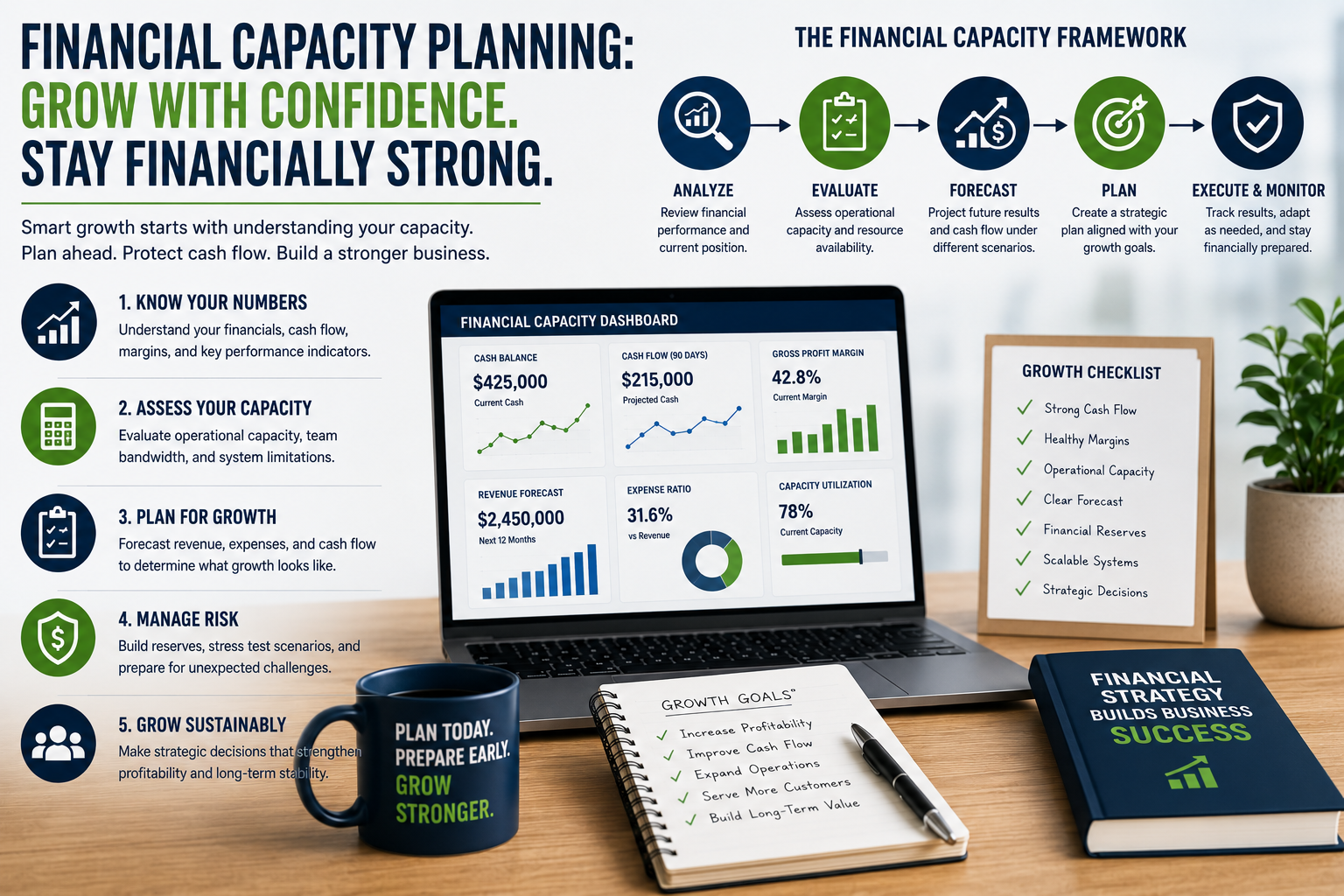

Growth is exciting for small businesses.
More customers, increasing revenue, expanding teams, and new opportunities often signal progress. But many businesses discover that growth can also create unexpected financial pressure.
Revenue increases do not automatically guarantee stability.
In fact, rapid growth often exposes weaknesses in:
- Cash flow management
- Operational planning
- Hiring decisions
- Expense control
- Resource allocation
- Financial forecasting
Many businesses unintentionally create financial stress while trying to grow.
The articles available on Your Accounting Service Blog Posts frequently emphasize financial visibility, operational improvement, forecasting, KPI management, and strategic financial planning. A critical next step that complements these topics is understanding financial capacity planning.
Financial capacity planning helps businesses determine:
- How much growth they can realistically support
- When expansion becomes financially risky
- How to scale without damaging cash flow
- When to invest in staffing, systems, or infrastructure
- How to maintain operational stability during growth
This article explores how small businesses can build financial capacity planning systems that support long-term, sustainable growth without repeating topics already covered throughout the site.
What Is Financial Capacity Planning?
Financial capacity planning is the process of evaluating whether a business has the financial, operational, and cash flow resources necessary to support future growth.
It answers important questions such as:
- Can the business afford to hire additional staff?
- Is current cash flow strong enough to support expansion?
- How much operational capacity exists before systems become overloaded?
- Will increased sales improve profitability—or strain resources?
- How much working capital is required to sustain growth?
Many businesses focus heavily on generating growth opportunities without evaluating whether the organization has the capacity to support those opportunities effectively.
This creates instability.
Why Growth Often Creates Financial Pressure
Many small business owners assume higher revenue automatically improves financial health.
In reality, growth often increases financial demands faster than revenue collections arrive.
Examples include:
- Hiring employees before revenue stabilizes
- Purchasing inventory ahead of sales
- Expanding office or operational space
- Increasing marketing spend aggressively
- Investing in software or infrastructure upgrades
- Managing larger payroll obligations
- Carrying higher accounts receivable balances
As businesses scale, expenses frequently increase before cash flow catches up.
Without financial capacity planning, growth can create:
- Cash shortages
- Margin compression
- Operational overload
- Increased debt reliance
- Delayed vendor payments
- Team burnout
Sustainable growth requires preparation—not just opportunity.
Capacity Planning Helps Businesses Grow Strategically
One of the greatest advantages of financial capacity planning is that it creates intentional growth instead of reactive growth.
Reactive businesses often:
- Hire too quickly
- Overspend during growth periods
- Expand operations prematurely
- Overcommit resources
- Operate without sufficient cash reserves
Strategic businesses evaluate:
- Current operational capacity
- Financial runway
- Forecasted cash flow
- Profitability impact
- Resource utilization
- Staffing efficiency
This allows leadership to scale more confidently and reduce unnecessary financial risk.
Understanding Operational Capacity Matters
Financial growth is closely tied to operational capacity.
A business can only grow sustainably if its operations can support increased demand efficiently.
Operational capacity includes:
- Team bandwidth
- Workflow efficiency
- Service delivery systems
- Inventory management
- Customer support capability
- Technology infrastructure
When businesses exceed operational capacity without preparation:
- Errors increase
- Customer satisfaction declines
- Employees become overwhelmed
- Profitability suffers
- Cash flow slows
Capacity planning helps businesses identify operational limitations before they become major growth obstacles.
Why Cash Flow Forecasting Is Essential for Capacity Planning
Cash flow forecasting is one of the most important components of financial capacity planning.
Many businesses evaluate growth based only on projected revenue instead of projected liquidity.
This creates dangerous blind spots.
For example:
A business may secure several large new clients while simultaneously:
- Waiting 30–60 days for payment
- Increasing payroll immediately
- Purchasing additional inventory
- Expanding operational expenses
Revenue may look strong on paper while cash flow becomes unstable.
Strong forecasting systems help businesses evaluate:
- Timing of incoming cash
- Upcoming obligations
- Seasonal fluctuations
- Payroll sustainability
- Capital expenditure timing
- Working capital requirements
Forecasting transforms growth planning from hopeful assumptions into measurable financial strategy.
Capacity Planning Improves Hiring Decisions
Hiring is one of the largest financial commitments growing businesses make.
Many businesses hire reactively because:
- Workload increases temporarily
- Teams feel overwhelmed
- Leadership fears missed opportunities
However, premature hiring can significantly strain profitability and cash flow.
Capacity planning helps businesses determine:
- Whether demand increases are temporary or sustainable
- Which roles generate the highest operational value
- When automation may reduce labor needs
- Whether current processes are inefficient
Sometimes operational improvements create more scalability than immediate hiring.
Strategic hiring protects both profitability and operational stability.
Profitability Matters More Than Revenue Growth
One of the most important principles in financial capacity planning is understanding the difference between profitable growth and expensive growth.
Not all revenue creates financial improvement.
Some growth opportunities:
- Require excessive labor
- Produce low margins
- Create operational strain
- Increase customer support demands
- Extend collection timelines
Businesses should evaluate:
- Gross margin trends
- Customer profitability
- Cost-to-serve metrics
- Revenue quality
- Operational efficiency
A smaller amount of highly profitable revenue is often more sustainable than rapid low-margin expansion.
Capacity Planning Helps Prevent Operational Chaos
Operational chaos often occurs when growth outpaces systems.
Examples include:
- Delayed communication
- Inconsistent customer service
- Workflow bottlenecks
- Missed deadlines
- Staffing confusion
- Excessive overtime
- Reduced quality control
These problems frequently emerge because businesses expand faster than their infrastructure can support.
Capacity planning allows businesses to strengthen:
- Processes
- Documentation
- Team accountability
- Workflow systems
- Operational visibility
before scaling aggressively.
Growth becomes more sustainable when infrastructure grows alongside revenue.
Financial Reserves Create Growth Flexibility
Many businesses underestimate the importance of maintaining cash reserves during expansion.
Strong reserves provide flexibility when:
- Revenue fluctuates
- Expenses increase unexpectedly
- Growth takes longer than expected
- Economic conditions shift
- Operational delays occur
Businesses without reserves often make reactive decisions under pressure.
Examples include:
- Emergency borrowing
- Delayed payroll
- Reduced marketing
- Cutting staff too quickly
- Pausing growth initiatives abruptly
Financial capacity planning encourages businesses to grow from stability rather than urgency.
Capacity Planning Improves Strategic Decision-Making
One of the biggest advantages of financial capacity planning is improved clarity.
Businesses gain a better understanding of:
- Growth timing
- Operational readiness
- Resource allocation
- Financial sustainability
- Risk exposure
This improves strategic decision-making across:
- Hiring
- Pricing
- Marketing
- Expansion
- Vendor relationships
- Capital investments
Businesses with strong planning systems make decisions proactively instead of reactively.
Technology Supports Capacity Planning — But Systems Matter Most
Financial software and operational dashboards provide important visibility.
However, technology alone does not create scalability.
Businesses still need:
- Financial discipline
- Forecasting systems
- Operational accountability
- Strategic planning
- Leadership alignment
Technology improves visibility.
Systems improve execution.
The strongest businesses combine:
- Accurate bookkeeping
- KPI monitoring
- Cash flow forecasting
- Operational planning
- Financial leadership
- Scalable workflows
Together, these systems support sustainable growth.
Sustainable Growth Requires Financial Readiness
Many businesses focus aggressively on acquiring growth opportunities while neglecting financial readiness.
This creates instability.
Sustainable businesses scale differently.
They prepare financially before operational stress develops.
They evaluate:
- Cash flow impact
- Operational bandwidth
- Profitability sustainability
- Resource capacity
- Financial reserves
- Forecast reliability
This preparation allows businesses to grow with greater confidence and reduced financial pressure.
Final Thoughts
Growth alone does not create business success.
Sustainable growth requires financial and operational readiness.
Financial capacity planning helps businesses:
- Protect cash flow
- Improve decision-making
- Reduce operational stress
- Strengthen profitability
- Improve forecasting
- Scale more strategically
The businesses that scale successfully are rarely the ones growing the fastest without structure.
They are the ones building the financial and operational capacity necessary to support long-term growth sustainably.
For additional financial planning and business growth insights, explore the articles available through Your Accounting Service Blog Posts.