
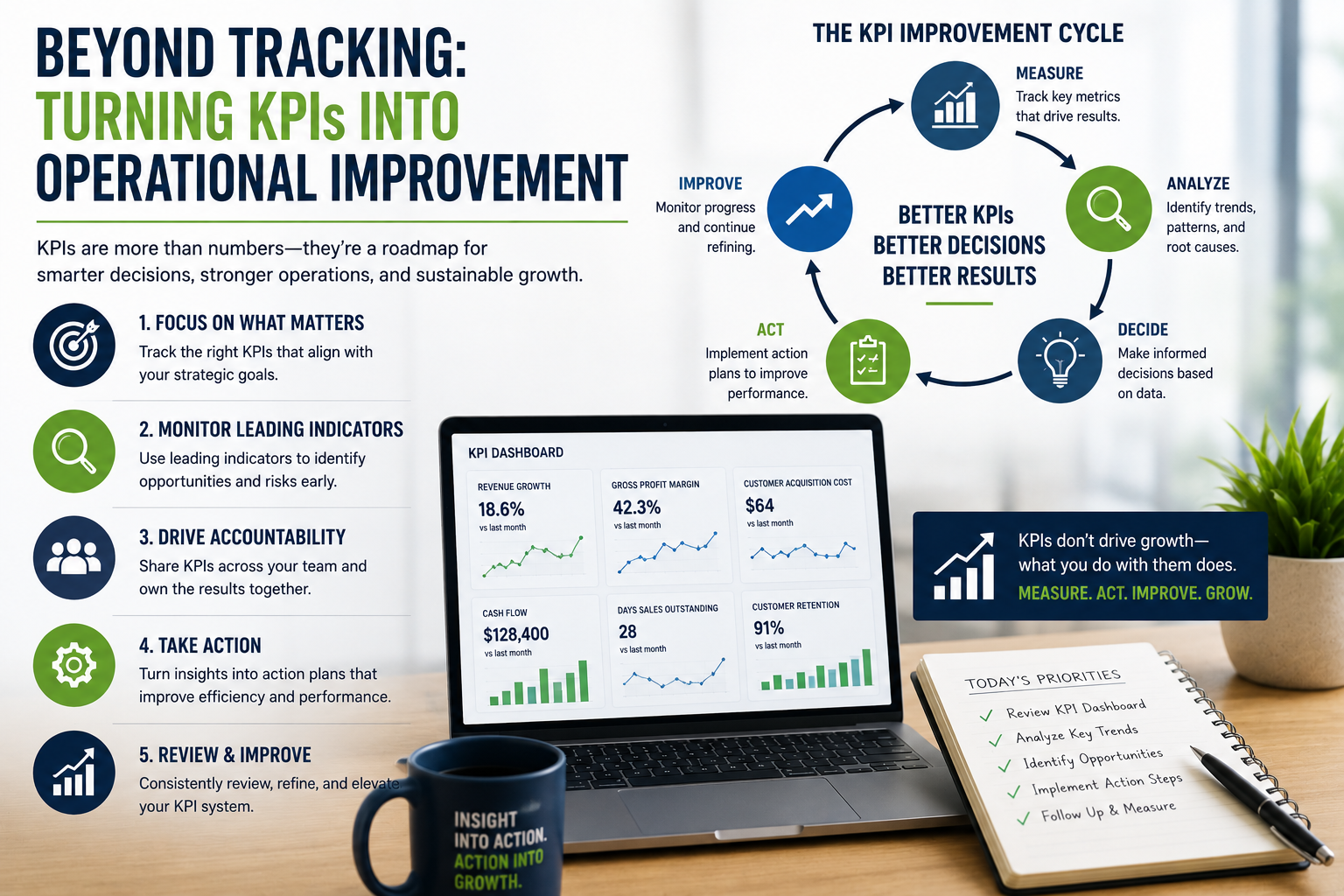

Key Performance Indicators (KPIs) are one of the most powerful tools a business can use to improve performance, increase profitability, and create sustainable growth.
But many businesses misunderstand how KPIs should actually function.
The article “What Are KPIs and How to Use Them Effectively” on Your Accounting Service Blog Posts explains the importance of measuring performance and identifying meaningful business metrics. However, many businesses still struggle with the next stage of KPI implementation:
How do you turn KPI tracking into real operational improvement?
Tracking numbers alone does not create growth.
The true value of KPIs comes from how businesses use those metrics to improve decision-making, operational efficiency, accountability, and long-term strategy.
This article explores how small businesses can move beyond simply monitoring KPIs and begin using them as operational guidance systems that drive measurable business improvement.
Why Many KPI Systems Fail
Most businesses initially adopt KPIs with good intentions.
They create dashboards.
Monitor reports.
Review charts.
Track monthly metrics.
Yet despite all the reporting, little actually changes operationally.
This happens because businesses often treat KPIs as passive scorecards instead of active management tools.
Common KPI mistakes include:
- Tracking too many metrics
- Measuring activity instead of outcomes
- Reviewing KPIs inconsistently
- Failing to connect KPIs to operational decisions
- Ignoring leading indicators
- Lack of accountability for results
- Using metrics without context
As a result, teams become overwhelmed with data while leadership still struggles to improve performance.
The issue is not the existence of KPIs.
The issue is whether the organization builds systems around those KPIs.
KPIs Should Drive Behavior — Not Just Reporting
Strong KPI systems influence daily decision-making.
They shape operational priorities, team accountability, and resource allocation.
For example:
A company tracking cash flow KPIs may tighten invoicing procedures and improve collections.
A company tracking labor efficiency may redesign workflows and staffing structures.
A company tracking customer acquisition costs may reallocate marketing spending toward higher-performing channels.
The KPI itself is not the solution.
The operational response to the KPI creates improvement.
This distinction is critical.
The Difference Between Lagging and Leading Indicators
One of the biggest reasons businesses struggle with KPI systems is they focus too heavily on historical metrics instead of predictive indicators.
Lagging Indicators
Lagging indicators measure outcomes that have already occurred.
Examples include:
- Net profit
- Revenue
- Year-end growth
- Gross profit
- Operating income
These metrics are important—but they explain the past.
Leading Indicators
Leading indicators help predict future performance.
Examples include:
- Sales pipeline activity
- Customer inquiries
- Proposal conversion rates
- Labor utilization
- Average project timelines
- Inventory turnover
- Accounts receivable aging
Leading indicators allow businesses to identify issues before financial damage occurs.
For example:
A decline in sales pipeline activity today may predict revenue problems months later.
An increase in overdue invoices may indicate future cash flow pressure.
Businesses that monitor leading indicators make faster, more proactive decisions.
KPI Systems Should Support Strategic Priorities
Not every metric deserves equal attention.
Businesses often create unnecessary complexity by tracking dozens of disconnected numbers.
Effective KPI systems focus on the metrics most directly connected to strategic goals.
For example:
Growth-Focused Businesses May Prioritize:
- Revenue growth rate
- Customer acquisition cost
- Conversion rates
- Revenue per employee
- Sales pipeline velocity
Profitability-Focused Businesses May Prioritize:
- Gross margin percentage
- Operating expense ratio
- Labor efficiency
- Net profit margin
- Cost per service delivered
Cash Flow-Focused Businesses May Prioritize:
- Days sales outstanding (DSO)
- Cash reserve levels
- Accounts payable timing
- Recurring revenue stability
- Collection cycle speed
The goal is not measuring everything.
The goal is measuring what matters most right now.
Operational Teams Need KPI Visibility
One of the most overlooked aspects of KPI implementation is operational communication.
In many small businesses, only ownership or accounting teams review KPIs.
This creates disconnects throughout the organization.
Employees cannot align with goals they do not understand.
For KPIs to influence operational performance, teams must understand:
- What metrics matter
- Why those metrics matter
- How their actions influence results
- What success looks like operationally
For example:
Sales Teams Should Understand:
- Gross margin targets
- Customer profitability
- Lead conversion quality
- Collection expectations
Operations Teams Should Understand:
- Efficiency benchmarks
- Labor utilization goals
- Waste reduction targets
- Project profitability
Marketing Teams Should Understand:
- Customer acquisition costs
- Campaign ROI
- Lead quality metrics
- Customer lifetime value
When KPI visibility expands across departments, accountability improves significantly.
KPIs Create Faster Decision-Making
One major advantage of KPI systems is speed.
Businesses without structured metrics often rely on assumptions, intuition, or delayed financial reports.
This slows decision-making.
Well-designed KPI systems allow leadership to quickly identify:
- Declining profitability
- Rising operational costs
- Slowing collections
- Customer churn patterns
- Productivity problems
- Revenue concentration risks
The earlier businesses identify issues, the easier they are to correct.
Strong KPI systems shorten the time between:
- Identifying problems
- Analyzing causes
- Implementing solutions
This responsiveness becomes a competitive advantage.
Why KPI Review Cadence Matters
Even strong KPIs become ineffective if businesses review them inconsistently.
Many companies only review metrics monthly—or worse, quarterly.
That delay often allows operational problems to compound.
High-performing businesses establish structured KPI review systems.
Examples include:
Daily Reviews
Used for:
- Sales activity
- Production performance
- Customer support metrics
- Cash position monitoring
Weekly Reviews
Used for:
- Labor efficiency
- Marketing performance
- Accounts receivable
- Operational bottlenecks
Monthly Reviews
Used for:
- Financial performance
- Profitability analysis
- Budget variance analysis
- Strategic forecasting
Consistent review cadence creates organizational awareness and operational discipline.
KPIs Should Trigger Action Plans
One of the biggest failures in KPI management is reviewing metrics without creating action steps.
Businesses should define:
- Performance thresholds
- Warning indicators
- Corrective action plans
- Accountability ownership
For example:
If gross margins fall below target:
- Review pricing strategy
- Analyze labor costs
- Evaluate vendor expenses
- Identify inefficiencies
If customer acquisition costs rise:
- Reassess marketing channels
- Improve conversion systems
- Refine customer targeting
If accounts receivable slows:
- Tighten collections procedures
- Adjust payment terms
- Improve invoicing speed
KPIs become powerful when they trigger operational responses.
Technology Improves Visibility — But Systems Drive Results
Modern accounting and dashboard software provides incredible visibility into business performance.
However, software alone does not improve a business.
Businesses still need:
- Strategic interpretation
- Operational accountability
- Leadership discipline
- Action-oriented processes
Technology supports measurement.
Systems create improvement.
The most successful businesses combine:
- Accurate financial reporting
- KPI visibility
- Operational accountability
- Forecasting systems
- Structured decision-making
Together, these elements create sustainable operational growth.
KPI Systems Help Businesses Scale More Effectively
As businesses grow, complexity increases rapidly.
Without KPI systems, leadership often loses visibility into operational performance.
This creates:
- Reactive management
- Profitability erosion
- Cash flow instability
- Resource misallocation
- Team misalignment
Strong KPI systems provide structure during growth.
They help businesses:
- Maintain operational control
- Improve forecasting accuracy
- Increase accountability
- Identify inefficiencies early
- Scale sustainably
Growth without visibility creates chaos.
Growth with KPI-driven systems creates scalability.
Final Thoughts
KPIs are not simply reporting tools.
They are operational guidance systems.
Businesses that only monitor KPIs often remain reactive.
Businesses that use KPIs to improve operational execution gain a major competitive advantage.
They:
- Make faster decisions
- Improve efficiency
- Protect profitability
- Strengthen accountability
- Improve forecasting
- Scale more sustainably
The goal is not collecting more data.
The goal is creating better decisions from the data you already have.
For additional financial strategy and business growth insights, explore the articles available through Your Accounting Service Blog Posts.