
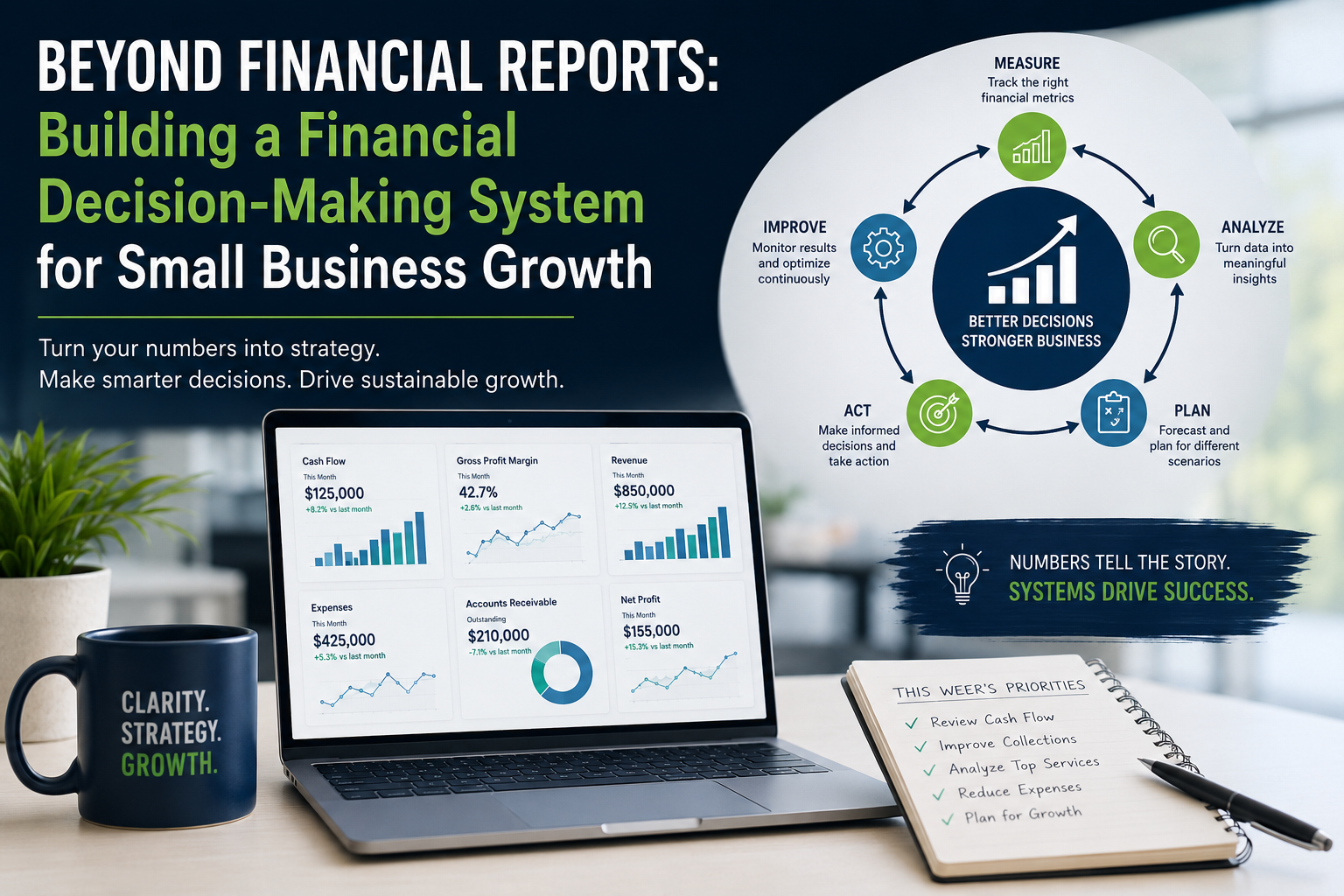

Many small business owners eventually reach a turning point where basic bookkeeping and financial reporting are no longer enough. They may already understand how to read their numbers, review profit and loss statements, or monitor cash flow. But the next challenge is far more important:
How do you consistently turn financial information into better operational decisions?
The article “From Financial Reports to Financial Strategy: How Small Businesses Turn Numbers Into Growth” on Your Accounting Service Blog Posts explains how financial reports can become strategic tools instead of historical documents. The next step is building a repeatable financial decision-making system that transforms insights into measurable action.
Without a structured process, even the best financial reports become unused data.
This article explores how growing businesses can create systems that connect accounting, operations, forecasting, and leadership decisions together—allowing business owners to scale with clarity instead of reacting to problems after they occur.
Why Financial Information Alone Is Not Enough
Most businesses already collect financial data.
They generate:
- Profit and loss statements
- Balance sheets
- Cash flow reports
- Accounts receivable reports
- Expense summaries
- Payroll reports
The problem is not the lack of information.
The problem is that many businesses lack a framework for interpreting and acting on the information consistently.
This creates several common issues:
- Delayed decision-making
- Poor cash management
- Reactive hiring
- Overspending during growth periods
- Underinvestment in profitable opportunities
- Confusion between revenue growth and profit growth
A business may technically be “profitable” while simultaneously struggling with cash shortages, operational inefficiencies, or declining margins.
Financial clarity only becomes valuable when it directly influences operational behavior.
The Difference Between Reporting and Decision Systems
Financial reporting tells you what happened.
A financial decision-making system tells you what to do next.
This distinction is critical.
Many small businesses stop at bookkeeping and reporting because they believe accurate financials alone will improve the business. In reality, reports are only the starting point.
A decision system connects financial data to:
- Weekly operational meetings
- Hiring decisions
- Pricing evaluations
- Marketing investments
- Inventory management
- Vendor negotiations
- Cash reserve planning
- Expansion timing
The businesses that grow sustainably are not necessarily the ones with the highest revenue.
They are often the businesses with the clearest operational feedback systems.
Step 1: Identify the Metrics That Actually Drive Growth
One of the biggest mistakes small businesses make is tracking too many metrics without identifying which numbers truly influence performance.
Not all financial data carries equal strategic value.
Instead of overwhelming leadership teams with dozens of reports, businesses should identify a small group of core operational financial drivers.
Examples include:
Gross Profit Margin
Revenue growth means very little if margins continue shrinking.
Tracking gross margin helps businesses understand:
- Whether pricing supports profitability
- Whether labor costs are becoming excessive
- Whether materials or vendor costs are increasing
- Which services or products generate the highest returns
Gross margin is often one of the clearest indicators of operational efficiency.
Cash Conversion Cycle
Many profitable businesses still struggle because cash moves too slowly.
A business may wait:
- 30 days to invoice
- 45 days to collect payment
- While paying vendors within 15 days
This creates cash pressure even when sales appear healthy.
Monitoring cash conversion timelines helps businesses improve liquidity without relying on debt.
Revenue Per Employee
This metric helps evaluate operational efficiency and staffing scalability.
As businesses grow, payroll frequently increases faster than productivity.
Tracking revenue per employee helps determine:
- Whether hiring is sustainable
- Whether automation is needed
- Whether workflows are inefficient
Customer Acquisition Cost (CAC)
Marketing spending without measurement becomes dangerous quickly.
Businesses should understand:
- How much it costs to acquire a customer
- Which channels generate the best ROI
- Whether customer lifetime value justifies marketing investments
Without these insights, growth can actually destroy profitability.
Step 2: Turn Monthly Reporting Into Weekly Operational Reviews
Many businesses wait until month-end financials are complete before discussing performance.
That delay is expensive.
Fast-growing companies create weekly review systems that combine operational metrics with financial indicators.
These meetings should focus on questions such as:
- Are collections slowing down?
- Are labor costs increasing unexpectedly?
- Which services produced the highest margins this week?
- Which projects are underperforming?
- Are marketing campaigns generating profitable leads?
- Is inventory moving too slowly?
- Are expenses increasing faster than revenue?
The goal is to shorten the time between identifying problems and correcting them.
Businesses that react quickly usually outperform businesses with better reports but slower decision-making.
Step 3: Create Forecasting Systems Instead of Static Budgets
Traditional annual budgets often become outdated quickly.
Markets change.
Customer behavior changes.
Costs change.
Economic conditions change.
Instead of relying solely on static annual budgets, businesses should maintain rolling forecasts.
A rolling forecast continuously updates projections based on real-world performance.
This allows leadership teams to:
- Adjust hiring plans early
- Reduce unnecessary spending before cash problems appear
- Reallocate marketing budgets toward higher-performing channels
- Delay risky expansion decisions
- Increase investments in profitable opportunities
Forecasting creates agility.
Static budgeting often creates rigidity.
This aligns closely with other financial planning concepts discussed throughout Your Accounting Service Blog Posts, particularly articles focused on budgeting, forecasting, and financial visibility.
Step 4: Build Financial Accountability Across the Team
One major reason financial strategies fail is because leadership keeps financial information isolated.
When only owners or accountants understand the numbers, teams struggle to align their actions with company goals.
Financial accountability should extend into operations.
For example:
Sales Teams
Should understand:
- Target margins
- Customer profitability
- Payment collection expectations
Operations Teams
Should understand:
- Labor efficiency targets
- Inventory carrying costs
- Waste reduction goals
Marketing Teams
Should understand:
- Customer acquisition cost
- Lead conversion value
- Campaign ROI
When departments understand how their actions impact profitability and cash flow, decision-making improves across the organization.
Step 5: Use Financial Data to Eliminate Operational Friction
Financial systems often reveal operational weaknesses long before they become major business problems.
Examples include:
- Increasing overtime costs
- Declining project profitability
- Slow invoice collections
- Rising software expenses
- Overstocked inventory
- Excessive customer churn
- Inefficient staffing structures
These issues are operational problems with financial symptoms.
The businesses that scale effectively are the ones that identify these warning signs early and address root causes before they escalate.
Financial reporting should not simply explain the past.
It should expose operational friction in real time.
Step 6: Build Cash Reserves Strategically
Growth creates risk.
As businesses expand, expenses typically rise before revenue stabilizes.
Without adequate cash reserves, even growing companies can experience major financial pressure.
Strong financial decision systems help businesses determine:
- Minimum operating cash requirements
- Emergency reserve targets
- Seasonal cash flow patterns
- Capital expenditure timing
- Debt management strategies
Cash reserves provide flexibility.
They allow businesses to:
- Handle downturns
- Invest during opportunities
- Avoid panic-based decisions
- Maintain operational stability
Cash flow stability often matters more than short-term revenue spikes.
Technology Should Support Strategy — Not Replace It
Accounting software is important, but software alone does not create financial intelligence.
Many businesses invest heavily in tools without building processes around those tools.
Technology should simplify:
- Reporting
- Forecasting
- KPI tracking
- Invoice management
- Expense monitoring
- Cash flow visibility
But leadership still must interpret the information and make strategic decisions.
The best systems combine:
- Accurate bookkeeping
- Real-time reporting
- Forecasting
- Operational accountability
- Strategic planning
Technology enhances visibility.
Systems create transformation.
The Businesses That Win Financially Move Faster
One of the greatest competitive advantages for small businesses is speed.
Large corporations often move slowly because of bureaucracy and complex approval systems.
Small businesses can adapt quickly—but only if they have clear financial visibility.
When leadership understands:
- Which services are most profitable
- Which expenses create unnecessary drag
- Which customers generate the highest value
- Which operational issues threaten margins
They can make faster, smarter decisions.
That speed compounds over time.
Final Thoughts
Financial reports are not the final destination.
They are the foundation for better operational decisions, stronger forecasting, improved cash flow management, and sustainable growth.
Businesses that only “review the numbers” often remain reactive.
Businesses that build structured financial decision-making systems become proactive.
They identify problems earlier.
They allocate resources more effectively.
They scale with greater confidence.
They reduce unnecessary financial stress.
The true value of accounting is not compliance.
It is clarity.
And clarity, when paired with action, becomes one of the most powerful growth tools a business can have.
For additional financial management and operational strategy insights, explore related content available through Your Accounting Service Blog Posts.