
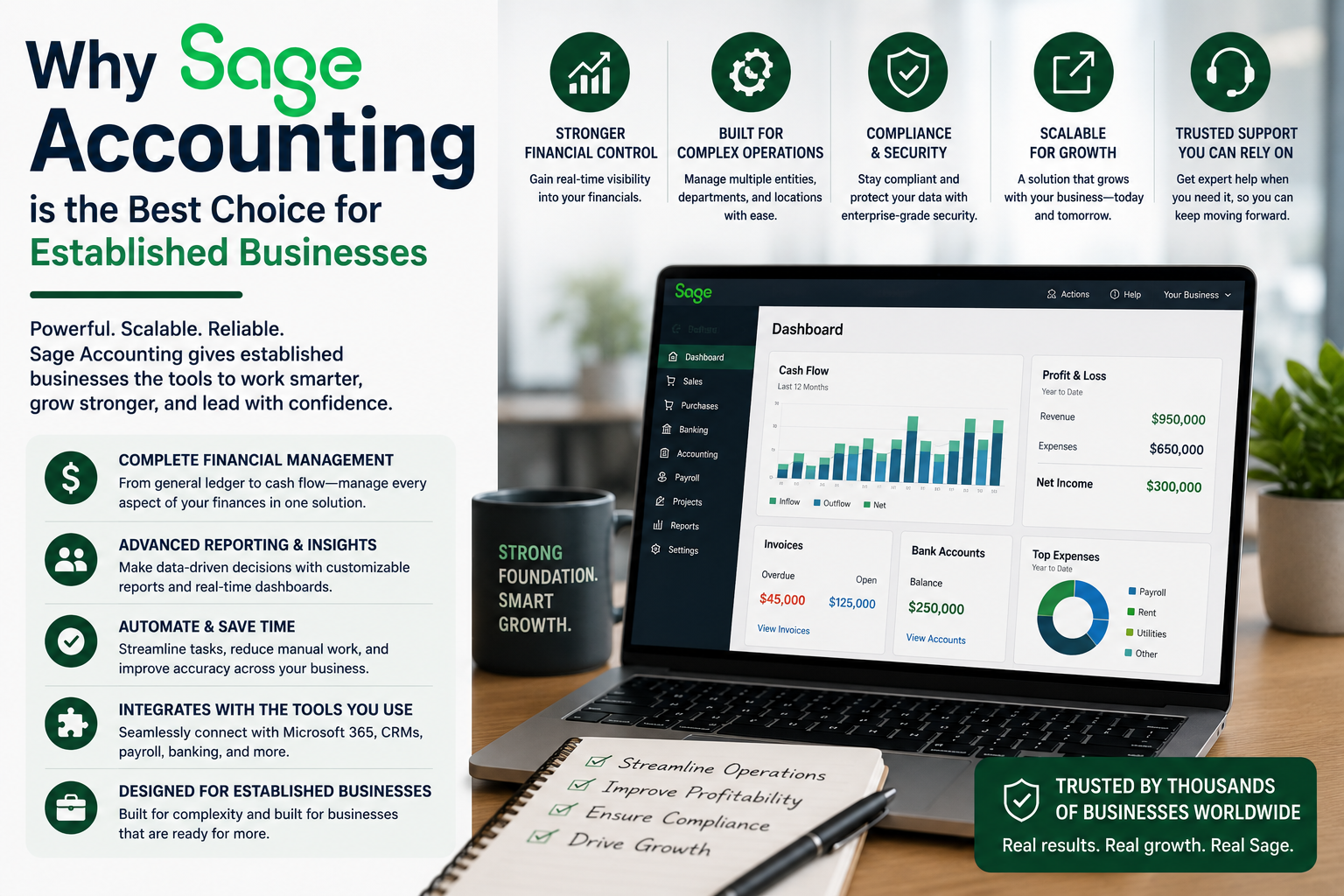

As businesses grow, their financial needs become more complex. What worked in the early stages—basic bookkeeping tools or simple accounting software—often isn’t enough to support scaling operations, inventory management, multi-department reporting, and compliance.
That’s where Sage Accounting excels.
Sage is widely recognized as a powerful, scalable accounting solution designed for established businesses that need deeper financial control, advanced reporting, and long-term reliability.
What Is Sage Accounting?

Sage Accounting is a comprehensive financial management platform that offers a range of products (such as Sage 50 and Sage Business Cloud) tailored to growing and established businesses.
It combines:
- Advanced accounting features
- Inventory and job costing tools
- Real-time reporting
- Automation and AI-driven insights
Sage solutions are built to handle more complex financial environments, making them ideal for businesses that have moved beyond the startup phase.
Why Sage Is the Best for Established Businesses
1. Advanced Financial Management Capabilities

Established businesses need more than basic bookkeeping—they need deep financial visibility.
Sage provides:
- Detailed financial reporting
- Cash flow forecasting
- Budgeting and job costing tools
- Real-time performance insights
These capabilities allow businesses to analyze trends, control costs, and make strategic decisions with confidence.
2. Strong Inventory and Operational Control

For product-based or operationally complex businesses, inventory is critical—and Sage delivers.
Key inventory features include:
- Stock level tracking
- Purchase order management
- Inventory valuation reporting
- Sales and demand insights
Sage helps businesses optimize inventory, reduce waste, and improve profitability.
3. Scalability That Supports Long-Term Growth
One of Sage’s biggest advantages is its ability to scale alongside your business.
As your company grows, Sage can handle:
- Increased transaction volume
- Multiple users and departments
- Multi-currency operations
- Complex financial structures
Sage is designed to support businesses from small operations to enterprise-level systems, making it a long-term solution rather than a temporary tool.
4. Automation and AI-Driven Efficiency

Sage incorporates automation and AI-powered tools (like Sage Copilot) to reduce manual work.
Automation features include:
- Automated invoicing and billing
- Bank reconciliation and transaction matching
- Expense tracking and categorization
- Payroll and compliance automation
These tools can save significant time—reportedly reducing administrative workload by several hours per week.
5. Real-Time Insights for Strategic Decision-Making
Established businesses rely heavily on data.
Sage provides:
- Real-time financial dashboards
- Customizable reports
- Profitability analysis
- Forecasting tools
This allows leadership teams to make proactive decisions instead of reactive ones, improving agility and long-term performance.
6. High-Level Security and Reliability

Established businesses need strong data protection—and Sage delivers.
It is known for:
- Secure cloud storage and backups
- Reliable system performance
- Strong data integrity controls
This ensures your financial data remains accurate, protected, and accessible when needed.
7. Built for Complex Business Needs
Sage is not just accounting software—it’s a full financial management system.
It supports:
- Job costing and project tracking
- Multi-entity accounting
- Compliance and tax management
- Integration with ERP systems
This makes it ideal for:
- Established small businesses
- Mid-sized companies
- Growing enterprises
The Downsides of Sage Accounting
While Sage is powerful, it’s not for everyone:
❌ Learning Curve
Because of its advanced features, Sage can be more complex than beginner-friendly platforms.
❌ Higher Cost of Ownership
Compared to entry-level software, Sage may require a larger investment—especially for advanced plans.
❌ Not Ideal for Very Small Businesses
Freelancers or simple businesses may find Sage more robust than necessary.
Sage vs. Other Accounting Software
Sage stands apart from tools like FreshBooks, Zoho Books, and even Xero in one key area: depth and capability.
- FreshBooks → Best for freelancers
- Zoho Books → Best value for small businesses
- Xero → Best for team collaboration
- Sage → Best for established businesses with complexity
Sage is built for companies that need more control, more insight, and more scalability.
Final Verdict: Why Sage Wins for Established Businesses
Sage Accounting is not the simplest or cheapest option—but that’s not its purpose.
It’s designed for businesses that have outgrown basic tools and need a robust, scalable financial system.
Sage stands out because it:
- Provides advanced financial reporting and analytics
- Handles complex operations like inventory and job costing
- Scales with business growth
- Automates critical financial processes
- Delivers real-time insights for strategic decisions
For established businesses looking to level up their financial management, Sage is one of the most powerful and reliable solutions available.