

Introduction
Most small business owners spend significant time planning for growth.
They focus on:
- increasing revenue,
- improving profitability,
- hiring employees,
- expanding operations,
- and serving more customers.
While growth is important, many businesses overlook another critical objective:
Financial resilience.
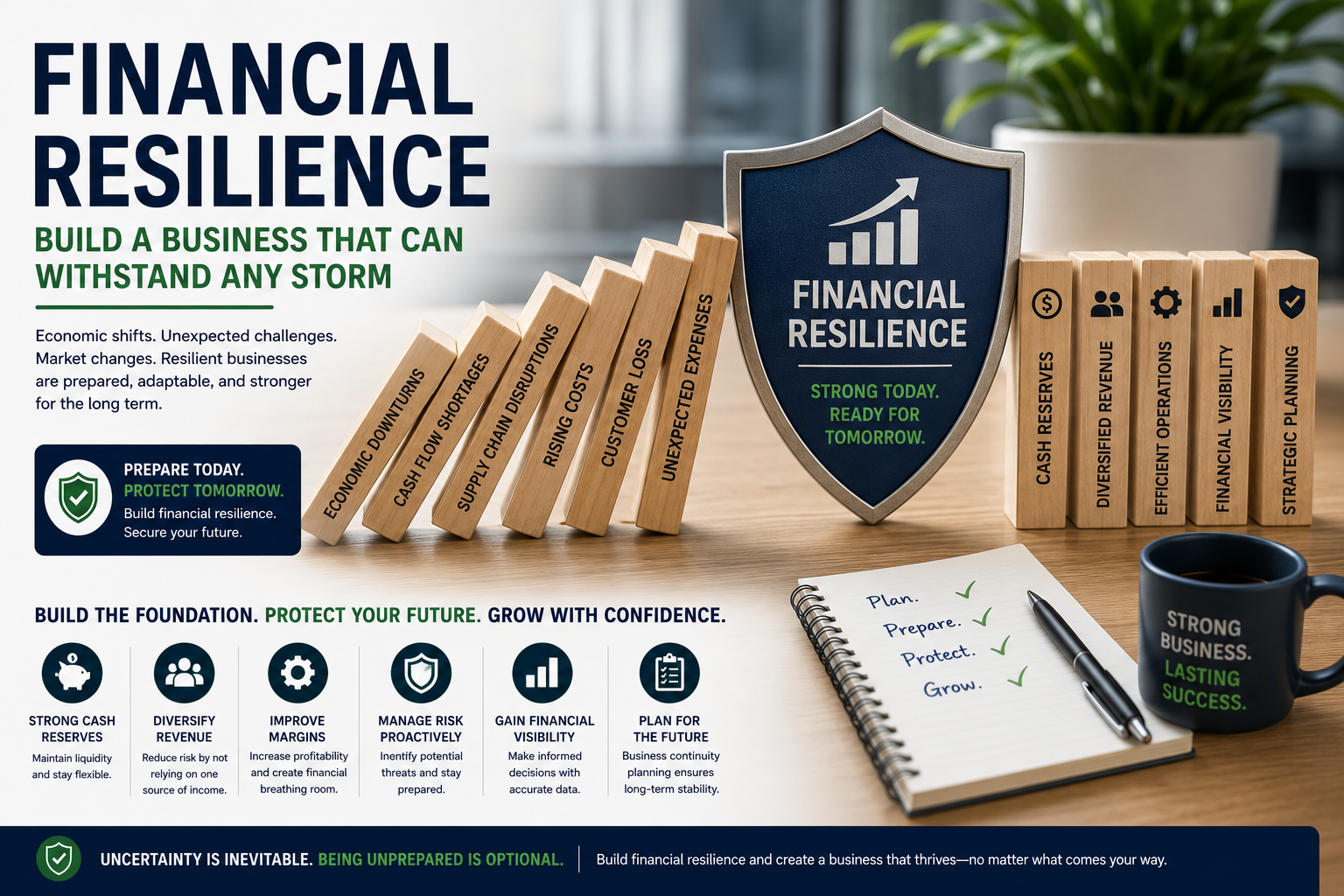
Financial resilience is a company’s ability to withstand unexpected disruptions while continuing to operate effectively.
Economic slowdowns, supply chain disruptions, customer losses, market shifts, inflation, labor shortages, and unexpected expenses can impact even the healthiest businesses.
The businesses that survive and thrive over the long term are often not the fastest growing businesses.
They are the businesses that are prepared.
What Is Financial Resilience?
Financial resilience refers to a company’s ability to:
- absorb financial shocks,
- adapt to changing market conditions,
- maintain operational stability,
- protect cash flow,
- and continue making strategic decisions during periods of uncertainty.
Resilient businesses do not rely on perfect economic conditions.
Instead, they create systems that allow them to remain flexible when circumstances change.
Financial resilience is not built overnight.
It is created through intentional planning and disciplined financial management.
Why Financial Resilience Matters
Unexpected events occur in every business.
Examples include:
- losing a major customer,
- supply chain disruptions,
- equipment failures,
- economic downturns,
- regulatory changes,
- rising operating costs,
- or staffing challenges.
Businesses without financial resilience often respond reactively.
They may:
- cut critical investments,
- delay important decisions,
- increase debt,
- or make short-term choices that create long-term problems.
Resilient businesses are able to respond strategically rather than emotionally.
Building Strong Cash Reserves
One of the most important components of financial resilience is liquidity.
Cash provides flexibility.
Businesses with healthy cash reserves can:
- cover unexpected expenses,
- maintain operations during revenue fluctuations,
- take advantage of growth opportunities,
- and reduce reliance on debt.
Many businesses operate with insufficient cash reserves because they focus exclusively on revenue growth.
Revenue is important.
Cash availability is what provides stability.
A practical goal is establishing reserve targets based on:
- fixed operating expenses,
- payroll obligations,
- debt requirements,
- and expected cash flow volatility.
Diversifying Revenue Sources
Businesses that rely heavily on one customer, product, or revenue stream often face higher financial risk.
Revenue concentration creates vulnerability.
If a significant source of revenue declines unexpectedly, business performance can deteriorate quickly.
Financially resilient companies often diversify through:
- additional service offerings,
- recurring revenue programs,
- strategic partnerships,
- complementary products,
- or expanded customer segments.
Diversification helps reduce dependence on any single source of income.
Strengthening Gross Margins
Many businesses focus on increasing sales while ignoring profitability.
Revenue growth alone does not improve resilience.
Strong gross margins provide businesses with more flexibility during difficult periods.
Improving margins may involve:
- adjusting pricing strategies,
- negotiating supplier agreements,
- reducing waste,
- improving operational efficiency,
- and focusing on higher-value offerings.
Healthy margins create financial breathing room.
Reducing Dependency on Key Individuals
Operational resilience and financial resilience are closely connected.
Many businesses become dependent on:
- owners,
- key employees,
- or specific departments.
When too much knowledge resides with a small number of individuals, operational disruptions can quickly become financial problems.
Businesses should document:
- procedures,
- workflows,
- customer processes,
- vendor relationships,
- and operational responsibilities.
Systemized businesses recover faster from unexpected disruptions.
Managing Debt Strategically
Debt can support growth when used responsibly.
However, excessive debt can reduce resilience.
Businesses should regularly evaluate:
- debt service coverage,
- interest expenses,
- repayment schedules,
- and financing flexibility.
Financial resilience requires maintaining manageable debt levels that support growth without creating unnecessary risk.
Creating a Business Continuity Plan
Many small businesses operate without a formal contingency plan.
A business continuity plan outlines how the organization will respond to unexpected events.
This plan may include:
- emergency communication procedures,
- backup systems,
- financial contingency strategies,
- supplier alternatives,
- remote work capabilities,
- and operational recovery procedures.
Preparation reduces uncertainty and accelerates recovery.
Monitoring Leading Indicators
Financially resilient businesses monitor early warning signs.
These indicators often reveal potential issues before they become major problems.
Examples include:
- declining sales activity,
- slowing collections,
- customer churn,
- rising expenses,
- shrinking margins,
- and reduced cash flow.
Early detection allows leadership teams to take corrective action sooner.
Stress Testing Your Business
One of the most effective resilience exercises is financial stress testing.
Business owners should regularly ask:
- What happens if revenue declines by 20%?
- What if expenses increase by 15%?
- What if a major customer leaves?
- What if hiring costs rise significantly?
Scenario planning helps identify vulnerabilities before they become emergencies.
Businesses that test assumptions are better prepared for unexpected challenges.
Investing in Financial Visibility
Resilience depends on visibility.
Business owners cannot respond effectively to challenges they cannot see.
Accurate financial reporting helps leaders understand:
- profitability,
- cash flow,
- liquidity,
- debt exposure,
- and operational performance.
The better your visibility, the faster and more confidently you can respond to changing conditions.
The Long-Term Advantage of Resilience
Financial resilience is often viewed as a defensive strategy.
In reality, it creates offensive advantages.
Businesses with strong financial foundations can:
- invest during downturns,
- acquire competitors,
- hire strategically,
- expand into new markets,
- and capitalize on opportunities others cannot pursue.
Resilience provides optionality.
Optionality creates competitive advantage.
Final Thoughts
Every business will face uncertainty.
Economic conditions change.
Markets evolve.
Unexpected challenges emerge.
The goal is not eliminating risk.
The goal is building a business capable of adapting to risk without losing momentum.
By strengthening cash reserves, diversifying revenue, improving margins, reducing operational dependencies, and maintaining strong financial visibility, small businesses can build financial resilience that supports sustainable long-term success.
Growth is important.
But businesses that endure are the businesses that are prepared.