

Most business problems do not appear overnight.
Cash flow issues rarely begin with an empty bank account.
Profitability problems rarely start with a sudden loss.
Operational inefficiencies rarely emerge all at once.
Instead, most business challenges develop gradually.
Small warning signs appear first.
Margins begin shrinking.
Expenses creep upward.
Customer acquisition costs rise.
Collections slow down.
Productivity declines.
By the time many business owners recognize the problem, significant damage has already occurred.
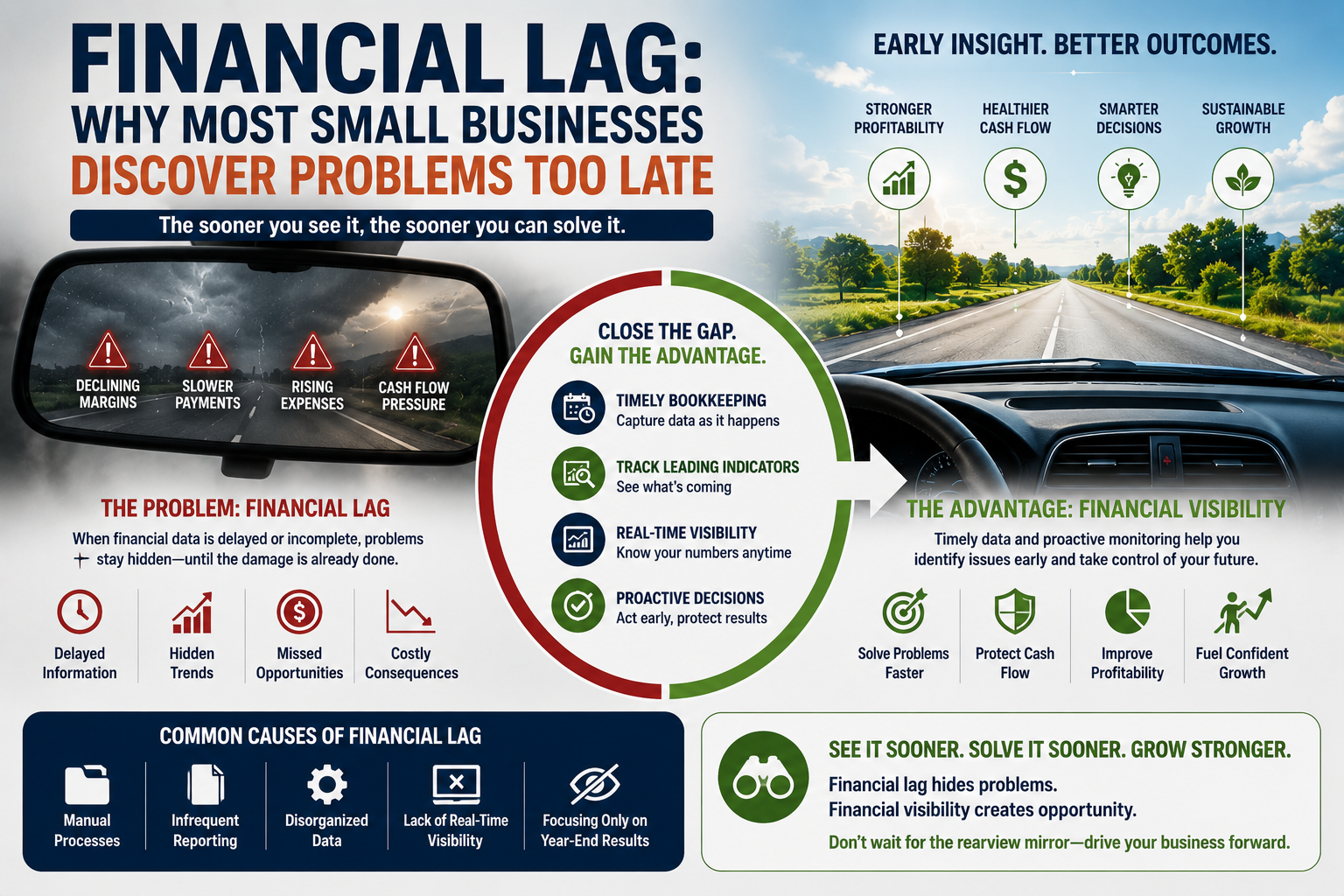
This delay between when a problem begins and when it is discovered is called financial lag.
Financial lag is one of the most overlooked threats to small business growth.
Businesses that learn how to identify and reduce financial lag often make better decisions, solve problems faster, and maintain stronger financial performance.
What Is Financial Lag?
Financial lag is the gap between when a financial issue begins and when leadership becomes aware of it.
Examples include:
- Declining profitability that goes unnoticed for months
- Increasing expenses hidden within growing revenue
- Cash flow issues that remain invisible until payroll becomes difficult
- Customer payment trends that slowly worsen
- Operational inefficiencies that gradually increase costs
The longer the lag, the larger the problem often becomes.
Why Financial Lag Is Dangerous
Business owners frequently make decisions based on outdated information.
When reports arrive weeks after activity occurs, leaders are essentially looking in the rearview mirror.
This creates several risks:
- Slow responses to emerging issues
- Missed opportunities
- Delayed corrective actions
- Increased financial losses
- Greater uncertainty
The goal is not simply obtaining information.
The goal is obtaining information early enough to influence outcomes.
The Hidden Sources of Financial Lag
Many businesses unknowingly create financial lag through inefficient processes.
Common causes include:
Delayed Bookkeeping
Transactions are entered weeks after they occur.
Infrequent Financial Reviews
Reports are reviewed monthly or quarterly rather than continuously.
Poor Data Organization
Information exists in multiple systems without consolidation.
Lack of Reporting Automation
Manual reporting processes create delays.
Limited Performance Monitoring
Leadership focuses only on major financial statements rather than operational indicators.
These factors reduce visibility and delay action.
Why Profitability Problems Often Go Undetected
Revenue growth can sometimes mask profitability issues.
A business may experience:
- Increasing sales
- Growing customer counts
- Higher revenue
Yet profitability may still decline.
This occurs because expenses often increase quietly.
Examples include:
- Labor inefficiencies
- Vendor price increases
- Rising overhead
- Margin compression
Without regular analysis, profitability deterioration may remain hidden.
Financial Lag and Cash Flow Challenges
Cash flow problems often develop long before they become emergencies.
Warning signs may include:
- Slower customer payments
- Increasing receivables
- Higher inventory levels
- Growing operating expenses
Businesses that identify these trends early can make adjustments before liquidity becomes a problem.
Those that wait often face more difficult decisions.
Leading Indicators vs. Lagging Indicators
One of the best ways to reduce financial lag is understanding the difference between leading and lagging indicators.
Lagging Indicators
These measure results after they occur.
Examples:
- Net profit
- Revenue
- Cash balances
- Annual growth
Leading Indicators
These help predict future performance.
Examples:
- Sales pipeline activity
- Proposal conversion rates
- Accounts receivable aging
- Customer retention trends
- Employee productivity
Leading indicators provide earlier visibility into future outcomes.
The Importance of Real-Time Financial Awareness
Businesses increasingly have access to tools that provide faster visibility into performance.
Real-time awareness helps leaders:
- Respond quickly
- Identify trends sooner
- Improve forecasting
- Reduce uncertainty
The faster leadership receives accurate information, the smaller financial lag becomes.
How Financial Lag Impacts Decision-Making
Every business decision depends on information.
When information is delayed:
- Hiring decisions become riskier
- Growth investments become harder to evaluate
- Pricing adjustments occur too late
- Expense reductions are delayed
Reducing financial lag improves decision quality because leaders work with more current information.
Building a Low-Lag Business
Businesses can reduce financial lag through several strategies.
Improve Bookkeeping Timeliness
Ensure financial data is updated consistently.
Review Key Metrics Frequently
Monitor performance regularly rather than waiting for month-end.
Automate Reporting
Reduce manual reporting delays.
Track Leading Indicators
Look beyond traditional financial statements.
Establish Financial Review Processes
Create recurring review schedules focused on trends and emerging risks.
These practices improve visibility and accelerate decision-making.
Why Small Businesses Have an Advantage
Large organizations often struggle with slow reporting systems and complex approval structures.
Small businesses can move faster.
They can:
- Review information more frequently
- Make decisions quickly
- Adapt rapidly to changing conditions
When combined with strong financial processes, this agility becomes a competitive advantage.
The Competitive Advantage of Early Awareness
Businesses rarely gain advantages by reacting late.
Competitive advantages often come from seeing changes before competitors do.
Early awareness allows businesses to:
- Protect margins
- Improve cash flow
- Allocate resources more effectively
- Respond to market changes
- Capitalize on emerging opportunities
The businesses that see problems first often solve them fastest.
Final Thoughts
Most business challenges provide warning signs before they become serious problems.
The issue is that many organizations fail to recognize those signals until it is too late.
Financial lag creates a dangerous gap between reality and awareness.
By improving bookkeeping timeliness, increasing financial visibility, monitoring leading indicators, and creating stronger reporting systems, businesses can shorten that gap significantly.
The sooner leaders recognize changes in performance, the sooner they can respond.
In business, awareness creates options.
And the earlier that awareness arrives, the more valuable it becomes.