

Most business owners focus on obvious challenges when trying to grow their companies.
They look at:
- Revenue targets
- Marketing performance
- Customer acquisition
- Hiring needs
- Cash flow
- Profitability
While these factors are important, many businesses overlook a silent growth killer that impacts nearly every aspect of the organization:
Financial friction.
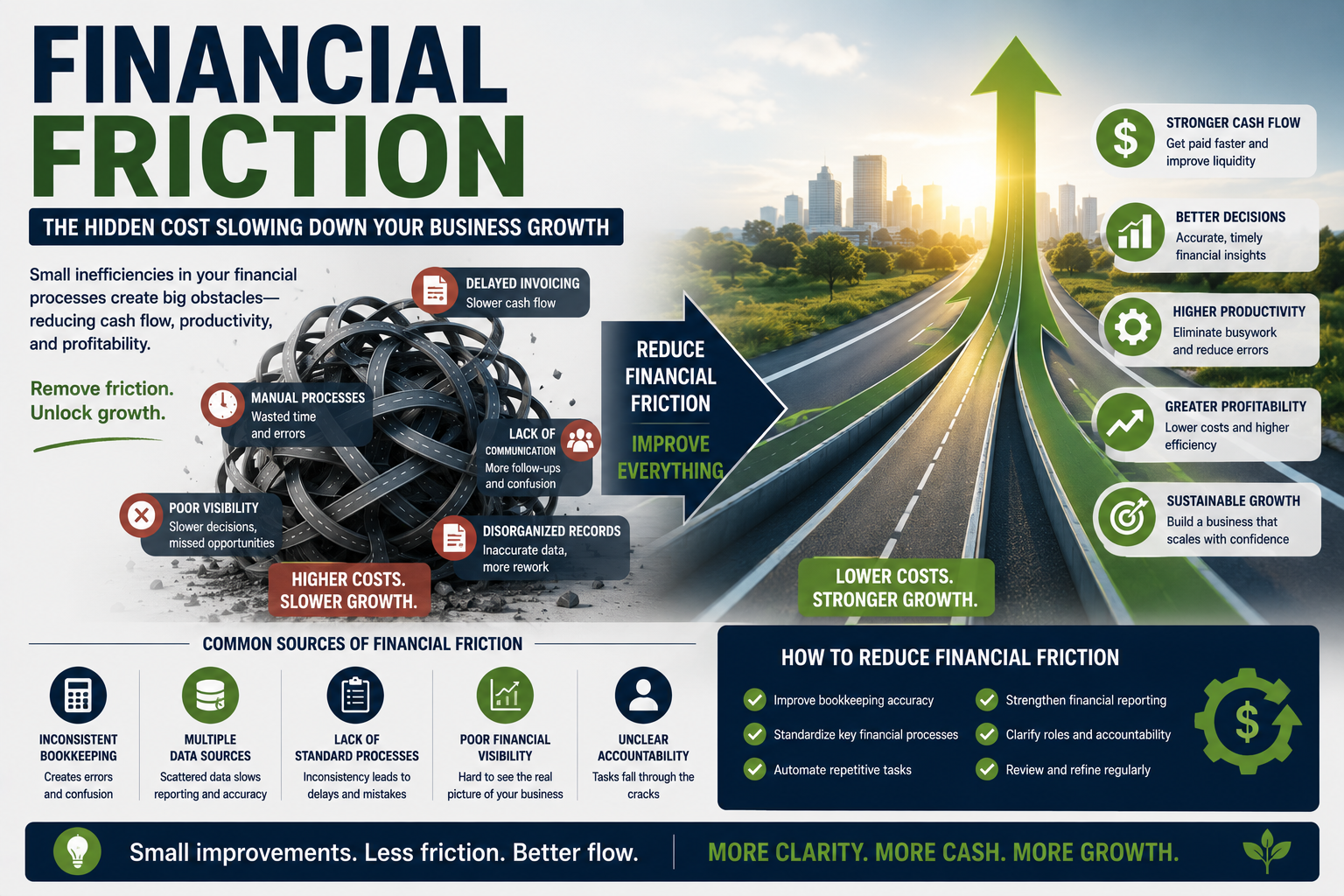
Financial friction refers to the unnecessary obstacles, delays, inefficiencies, and complications that prevent money, information, and decisions from moving efficiently through a business.
Unlike major financial problems, financial friction often develops gradually.
It hides inside everyday operations.
It appears as small inefficiencies that seem harmless individually but collectively reduce profitability, slow growth, and increase stress.
Businesses that identify and eliminate financial friction often discover opportunities for improvement without increasing sales or adding new customers.
What Is Financial Friction?
Financial friction occurs whenever unnecessary complexity creates inefficiency in a business.
Examples include:
- Delayed invoicing
- Unreconciled accounts
- Manual data entry
- Duplicate processes
- Poor communication between departments
- Slow approval processes
- Disorganized financial records
- Inconsistent reporting
These issues consume time, create errors, and delay decision-making.
Over time, they become expensive.
Why Financial Friction Is Difficult to Detect
Unlike declining revenue or cash shortages, financial friction rarely appears as a single major problem.
Instead, it shows up as:
- Constant administrative work
- Repeated corrections
- Frequent follow-ups
- Missed deadlines
- Delayed reports
- Slow decision-making
Because these issues become part of normal operations, many businesses fail to recognize their true cost.
The result is a gradual reduction in productivity and profitability.
The Hidden Cost of Delayed Information
Many business owners receive financial reports weeks after the information is needed.
By the time reports are reviewed:
- Opportunities may have passed
- Problems may have worsened
- Corrective actions may be delayed
Financial information is most valuable when it is timely.
The faster leaders receive accurate information, the faster they can make effective decisions.
Reducing reporting delays reduces financial friction.
How Financial Friction Impacts Cash Flow
Cash flow problems are not always caused by insufficient sales.
In many cases, they result from inefficient processes.
Examples include:
Slow Invoicing
The longer it takes to send invoices, the longer it takes to receive payment.
Weak Collections Procedures
Delayed follow-up often extends payment cycles.
Poor Expense Visibility
Unexpected expenses create unnecessary cash flow pressure.
Inefficient Approval Processes
Delays in financial approvals can affect both revenue collection and operational performance.
Removing friction from these areas often improves cash flow without increasing revenue.
Financial Friction and Employee Productivity
Employees frequently spend time working around inefficient systems.
Examples include:
- Searching for information
- Correcting bookkeeping errors
- Re-entering data
- Chasing approvals
- Resolving reporting discrepancies
These activities do not create value.
They simply consume resources.
Businesses that streamline processes often improve productivity while reducing operating costs.
Why Technology Alone Does Not Solve Financial Friction
Many organizations assume new software will eliminate inefficiencies.
Technology can help.
However, technology often magnifies existing problems if processes remain flawed.
Before implementing new tools, businesses should evaluate:
- Current workflows
- Reporting processes
- Data accuracy
- Communication procedures
- Accountability structures
Technology works best when paired with strong operational processes.
The Relationship Between Financial Friction and Growth
Growth naturally increases complexity.
As businesses grow, they add:
- Employees
- Customers
- Vendors
- Software systems
- Financial transactions
Without intentional process improvements, friction increases alongside growth.
Many businesses experience operational slowdowns not because they are growing too quickly, but because their systems have not evolved with the organization.
Common Sources of Financial Friction
Inconsistent Bookkeeping
Inaccurate records create confusion and increase correction efforts.
Multiple Data Sources
When information exists in several systems, reporting becomes difficult.
Lack of Standard Procedures
Inconsistent processes often lead to errors and delays.
Poor Financial Visibility
Limited access to accurate information slows decision-making.
Unclear Accountability
Without ownership, tasks frequently remain incomplete.
How Financial Friction Reduces Profitability
Every inefficiency has a cost.
Examples include:
- Increased labor costs
- Lost productivity
- Delayed collections
- Reporting errors
- Missed opportunities
- Poor resource allocation
While each issue may appear minor, the cumulative effect can significantly reduce profitability.
Businesses often discover substantial savings by eliminating friction rather than increasing sales.
Identifying Financial Friction in Your Business
Business owners should regularly ask:
- Where are delays occurring?
- Which tasks require repeated corrections?
- What processes consume excessive time?
- Where do communication breakdowns occur?
- Which reports are consistently late?
- What decisions take longer than they should?
The answers often reveal opportunities for improvement.
Reducing Financial Friction
Businesses can reduce financial friction by:
Improving Bookkeeping Accuracy
Reliable records create a stronger foundation for decision-making.
Standardizing Processes
Consistency improves efficiency and reduces errors.
Automating Repetitive Tasks
Automation reduces manual workload and improves accuracy.
Improving Financial Reporting
Timely reporting accelerates decision-making.
Clarifying Accountability
Clear ownership improves execution and follow-through.
The Long-Term Benefits of Reducing Friction
Businesses that eliminate financial friction often experience:
- Improved cash flow
- Higher profitability
- Better decision-making
- Faster growth
- Reduced stress
- Increased operational efficiency
Most importantly, leadership gains more time to focus on strategic initiatives rather than administrative challenges.
Final Thoughts
Many businesses believe growth requires major investments, significant changes, or dramatic transformations.
Often, meaningful improvement begins with removing obstacles that already exist.
Financial friction quietly drains resources, slows decisions, and limits profitability.
By identifying inefficiencies, improving financial visibility, streamlining processes, and creating stronger systems, businesses can unlock growth that was previously hidden behind operational complexity.
Sometimes the fastest path to growth is not adding more.
It is removing what is getting in the way.