

Most small business owners have goals.
They want to:
- Increase revenue
- Improve profitability
- Expand operations
- Hire additional employees
- Strengthen cash flow
- Build long-term value
The challenge is not setting goals.
The challenge is ensuring that daily decisions actually support those goals.
This is where many businesses struggle.
Leadership creates strategic objectives, but day-to-day operations often move in a different direction.
The result is a disconnect between what the business wants to achieve and what employees, managers, and systems are doing each day.
This disconnect is known as a lack of financial alignment.
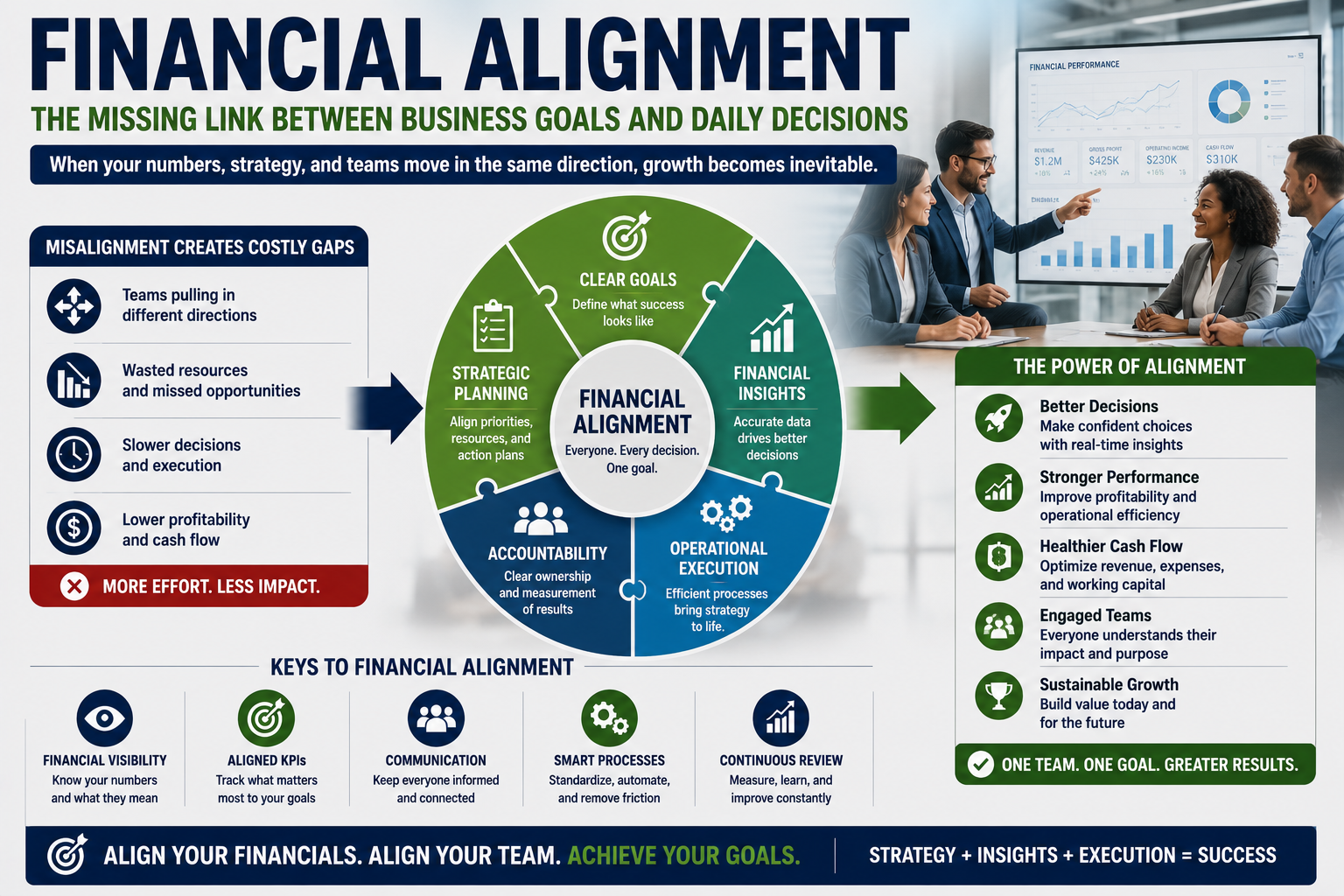
Financial alignment occurs when every major decision, process, and activity supports the financial objectives of the business.
Businesses that achieve strong financial alignment often grow faster, operate more efficiently, and make better decisions because everyone is moving in the same direction.
What Is Financial Alignment?
Financial alignment is the process of connecting financial goals to operational actions.
It ensures that:
- Strategic objectives influence decision-making
- Departments understand financial priorities
- Resources are allocated effectively
- Performance measurements support company goals
- Employees understand how their work impacts results
Without alignment, businesses frequently work hard without making meaningful progress.
Why Growth Often Creates Misalignment
As businesses grow, complexity increases.
Additional employees, departments, systems, and responsibilities create more opportunities for disconnect.
Common examples include:
Sales Pursuing Revenue at Any Cost
Revenue increases, but profitability declines.
Operations Prioritizing Efficiency Over Customer Experience
Costs improve, but customer retention suffers.
Marketing Focusing on Lead Volume Instead of Lead Quality
Activity increases, but revenue remains stagnant.
Leadership Chasing Too Many Priorities
Resources become fragmented across multiple initiatives.
When teams pursue different objectives, organizational performance suffers.
The Cost of Financial Misalignment
Financial misalignment creates hidden costs throughout the organization.
Examples include:
- Wasted resources
- Inefficient spending
- Delayed decision-making
- Lower profitability
- Reduced employee engagement
- Missed growth opportunities
Many businesses attempt to solve these problems with additional effort.
In reality, the issue is often direction rather than effort.
Why Financial Reports Alone Are Not Enough
Many businesses generate financial reports every month.
The problem is that reports alone do not create alignment.
Financial information only creates value when it influences behavior.
Businesses must translate financial insights into operational actions.
Questions leaders should ask include:
- What decisions should this information influence?
- Which departments are affected?
- What changes should occur as a result?
Reports should drive action, not simply provide information.
Connecting Goals to Daily Activities
One of the most effective ways to improve alignment is creating direct connections between goals and daily activities.
For example:
Goal: Improve Cash Flow
Daily actions may include:
- Faster invoicing
- Improved collections
- Expense monitoring
- Inventory optimization
Goal: Increase Profitability
Daily actions may include:
- Margin analysis
- Pricing reviews
- Cost control initiatives
- Operational improvements
Employees should understand how their responsibilities contribute to larger objectives.
The Role of Financial Visibility
Alignment requires visibility.
Leaders cannot align teams around information they do not possess.
Accurate financial reporting helps organizations:
- Identify trends
- Monitor performance
- Measure progress
- Detect problems early
Businesses with strong financial visibility typically make faster and more effective decisions. Financial dashboards and KPI systems can help leadership monitor performance and identify trends before they become major issues.
Aligning Key Performance Indicators
KPIs are most effective when they reinforce business objectives.
The best KPIs are directly connected to strategic goals and provide visibility into progress. Financial KPIs generally fall into categories such as profitability, liquidity, efficiency, and leverage, allowing businesses to monitor different dimensions of performance.
Examples include:
- Gross profit margin
- Cash conversion cycle
- Customer retention rate
- Operating cash flow
- Revenue growth rate
When KPIs align with strategy, decision-making improves throughout the organization.
Why Accountability Strengthens Alignment
Alignment requires ownership.
Without accountability, even the best plans struggle to produce results.
Businesses should clearly define:
- Who owns each objective
- Who measures progress
- Who makes decisions
- Who is responsible for implementation
Clear accountability reduces confusion and accelerates execution.
Financial Alignment and Resource Allocation
Every business has limited resources.
Time, money, and talent must be allocated carefully.
Financially aligned organizations invest resources based on strategic priorities rather than reacting to short-term distractions.
Questions to consider include:
- Does this investment support our goals?
- Does this initiative improve profitability?
- Will this improve long-term business value?
- Is this the highest-priority use of resources?
Alignment improves investment decisions.
The Leadership Responsibility
Financial alignment begins with leadership.
Leaders establish priorities, communicate expectations, and reinforce organizational objectives.
Strong leaders consistently connect:
- Financial goals
- Operational objectives
- Employee responsibilities
- Performance measurements
This creates clarity throughout the organization.
Signs Your Business May Lack Financial Alignment
Warning signs include:
- Teams working toward conflicting objectives
- Strong activity with weak results
- Repeated missed goals
- Confusion about priorities
- Excessive resource waste
- Frequent strategy changes
- Limited accountability
These indicators often suggest a need for stronger alignment.
The Long-Term Competitive Advantage
Businesses with strong financial alignment gain several advantages:
- Faster decision-making
- Better resource utilization
- Stronger profitability
- Improved accountability
- Increased operational efficiency
- Sustainable growth
Most importantly, they create momentum because every part of the organization contributes toward common objectives.
Final Thoughts
Many businesses assume growth comes from working harder.
In reality, sustainable growth often comes from working in the same direction.
Financial alignment ensures that strategy, operations, reporting, KPIs, and daily decisions all support the same objectives.
When employees understand priorities, leaders have visibility into performance, and resources are allocated strategically, businesses become more focused, efficient, and profitable.
Success becomes easier to achieve because everyone is pulling toward the same destination.
Growth is not simply about effort.
Growth is about alignment.