

Growth is often treated as a simple numbers game: more customers, more revenue, more success. But experienced operators know a harder truth—not all revenue is good revenue. In fact, the wrong customers can quietly drain your time, cash flow, and team morale while creating the illusion of growth.
If you want a healthier, more scalable business, the goal isn’t just to grow your customer base—it’s to improve the quality of your customers.
The Hidden Cost of “Bad” Revenue
At first glance, a sale is a sale. But over time, certain types of customers reveal themselves as liabilities rather than assets. These customers often bring in revenue that is:
- Delayed
- Unpredictable
- Expensive to service
- Emotionally draining for your team
Let’s break down the biggest red flags.
Watch Out For These Customer Types
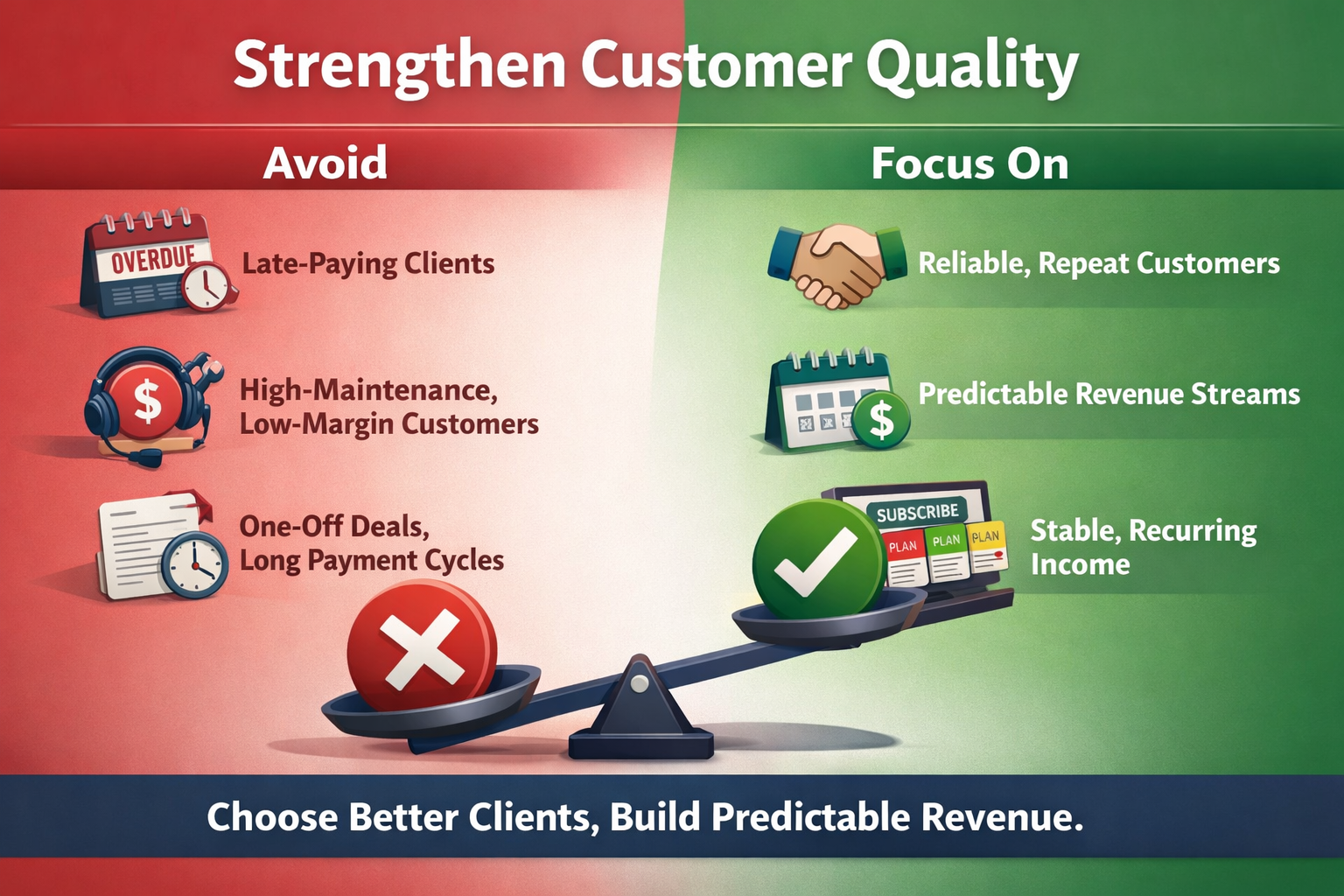
1. Late-Paying Clients
Cash flow is the lifeblood of any business. Late-paying clients disrupt that flow and create unnecessary stress.
- You spend time chasing invoices instead of building the business
- Forecasting becomes unreliable
- You may need to cover gaps with debt or reserves
A client who pays late consistently is not just inconvenient—they’re costing you money.
2. High-Maintenance, Low-Margin Customers
Some customers demand constant attention but contribute very little profit.
- Endless revisions
- Frequent calls and support requests
- Scope creep disguised as “quick asks”
These customers often feel valuable because they’re active, but in reality, they consume disproportionate resources. Over time, they reduce your ability to serve better clients.
3. One-Off Deals with Long Payment Cycles
Big deals can be tempting, especially early on. But if they’re:
- Non-recurring
- Slow to pay
- Complex to deliver
They can create revenue spikes without stability. You end up chasing the next deal instead of building a sustainable business.
The Opportunity Cost You’re Not Seeing
Every hour spent on a difficult, low-quality customer is an hour not spent on:
- Retaining your best clients
- Improving your product or service
- Building scalable systems
- Acquiring high-value customers
This is where many businesses stall. They’re busy—but not progressing.
What High-Quality Customers Look Like
Shifting your focus from quantity to quality starts with redefining what a “good customer” actually is.
1. Reliable, Repeat Customers
These are the backbone of strong businesses.
- They pay on time
- They come back consistently
- They trust your process
Repeat customers reduce acquisition costs and increase lifetime value. They also tend to be easier to work with because expectations are already aligned.
2. Predictable Revenue Streams
Predictability is power.
- Subscription models
- Retainers
- Long-term contracts
These structures allow you to:
- Forecast cash flow accurately
- Plan hiring and investments
- Reduce stress and volatility
Predictable revenue turns your business from reactive to strategic.
How to Strengthen Customer Quality
Improving customer quality isn’t about luck—it’s about intentional decisions.
1. Define Your Ideal Customer
Be specific.
- What industries do they operate in?
- What is their budget range?
- How do they behave as clients?
The clearer your definition, the easier it becomes to say yes to the right people and no to the wrong ones.
2. Set Boundaries Early
High-quality customers respect structure.
- Clear payment terms (and enforce them)
- Defined scope of work
- Communication expectations
The right clients will appreciate professionalism. The wrong ones will filter themselves out.
3. Price for Sustainability, Not Just Sales
Underpricing attracts the wrong customers.
When your pricing is too low:
- You attract bargain-seekers
- You increase workload without increasing profit
- You limit your ability to deliver quality
Strong pricing acts as a filter.
4. Build Systems for Retention
It’s easier (and cheaper) to keep a great customer than to find a new one.
- Regular check-ins
- Consistent delivery
- Proactive communication
Retention compounds over time and creates a stable foundation.
5. Audit Your Customer Base Regularly
Not all customers deserve to stay.
Ask:
- Who pays on time?
- Who is profitable?
- Who drains resources?
You may find that a small percentage of customers generate most of your value—while others quietly hold you back.
The Discipline of Saying No
One of the hardest but most important shifts is learning to turn down revenue that doesn’t fit.
Saying no to:
- A difficult client
- A low-margin deal
- A misaligned opportunity
…creates space for better opportunities to emerge.
This is where real growth begins.
Final Thought: Build a Business That Works Because of Your Customers, Not In Spite of Them
A strong business isn’t just defined by how many customers it has—but by who those customers are.
When you focus on customer quality:
- Cash flow improves
- Operations become smoother
- Your team performs better
- Growth becomes sustainable
Instead of chasing every dollar, start choosing the right dollars.
Because in the long run, the best businesses don’t just grow—they grow cleanly, predictably, and profitably.