
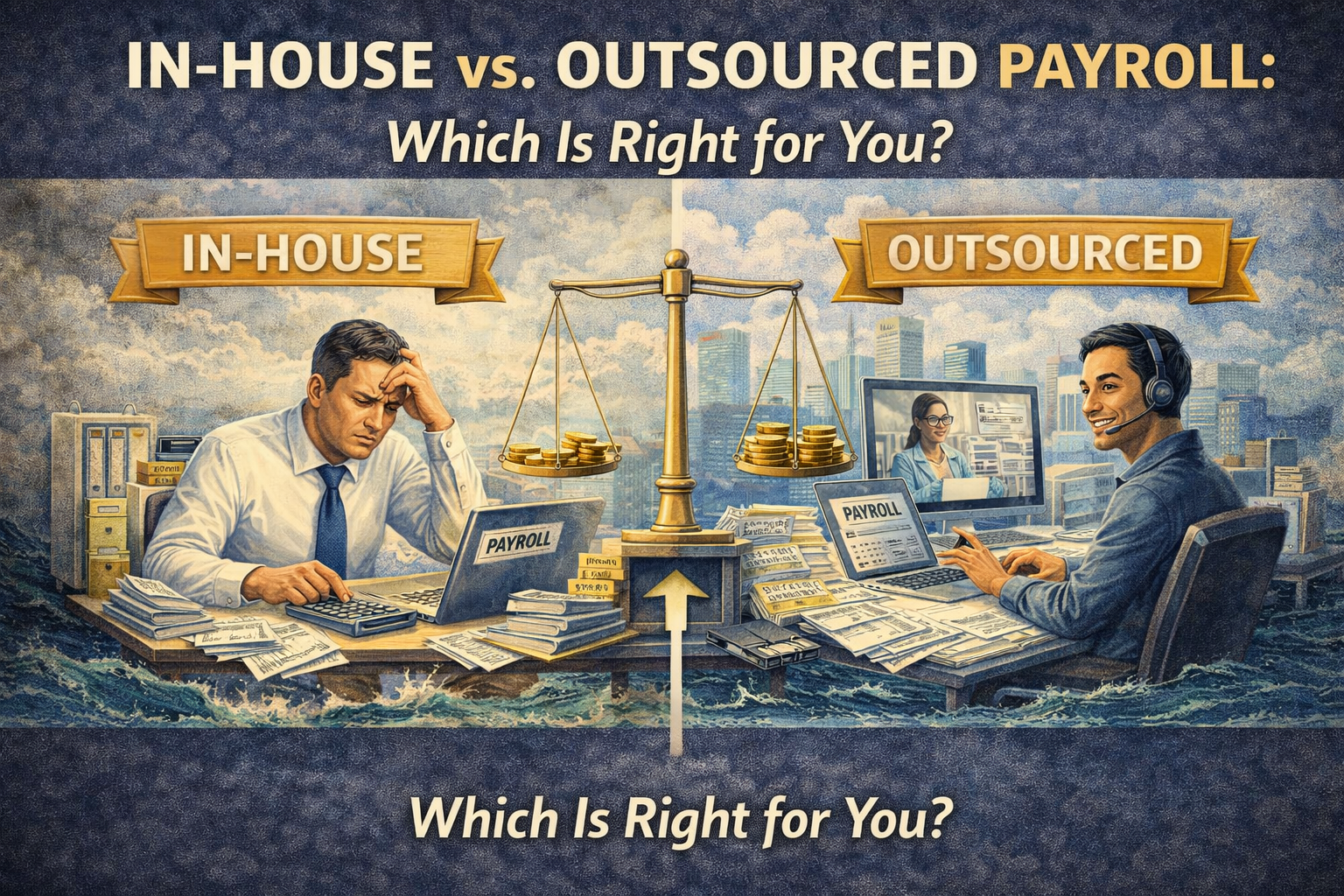

Payroll is one of the most critical—and sensitive—functions in any business. It directly impacts employee satisfaction, compliance with tax laws, and overall operational efficiency. Yet, one key decision continues to challenge business owners:
Should you manage payroll in-house or outsource it to a third-party provider?
The answer isn’t one-size-fits-all. It depends on your company’s size, growth stage, complexity, and internal capabilities. This guide breaks down everything you need to know to make the right choice.
What Is In-House Payroll?
In-house payroll means your internal team—typically HR or finance—handles all payroll processes, including:
- Calculating wages and deductions
- Filing payroll taxes
- Managing employee records
- Issuing payments
This approach gives you full ownership and control over payroll operations.
What Is Outsourced Payroll?
Outsourced payroll involves hiring an external provider to manage payroll tasks on your behalf. These providers can handle:
- Payroll processing and direct deposits
- Tax filings and compliance
- Benefits deductions
- Reporting and recordkeeping
Outsourcing shifts responsibility to specialists, often using advanced software and automation.
Key Differences at a Glance
| Factor | In-House Payroll | Outsourced Payroll |
|---|---|---|
| Control | Full control | Limited control |
| Cost | Fixed (staff + software) | Variable (subscription/service fees) |
| Expertise | Depends on your team | Access to specialists |
| Compliance | Your responsibility | Provider-managed |
| Time Investment | High | Low |
| Scalability | Limited by resources | Highly scalable |
Pros and Cons of In-House Payroll
✅ Advantages
1. Full Control and Flexibility
You can customize processes, make quick adjustments, and maintain direct oversight of payroll data.
2. Data Security Control
Sensitive employee information stays within your organization.
3. Immediate Issue Resolution
No waiting on external providers—problems can be handled instantly.
❌ Drawbacks
1. Time-Consuming and Resource-Heavy
Payroll requires ongoing management, reducing time for strategic work.
2. Compliance Risk
You’re responsible for staying up to date with changing tax laws and regulations.
3. Higher Hidden Costs
Costs include salaries, software, training, and potential penalties for errors.
Pros and Cons of Outsourced Payroll
✅ Advantages
1. Significant Time Savings
Outsourcing frees your team to focus on growth and core operations.
2. Expertise and Compliance Support
Providers specialize in payroll laws, reducing risk of errors and penalties.
3. Scalability
Easily handle growth, multi-state operations, or global teams.
4. Improved Accuracy
Professional systems and processes reduce payroll errors.
❌ Drawbacks
1. Less Direct Control
You rely on a third party’s processes and timelines.
2. Ongoing Costs
Monthly or per-employee fees can add up over time.
3. Data Sharing Concerns
Sensitive employee data is handled externally.
Cost Comparison: What’s More Affordable?
The cost difference can be substantial depending on your business size.
- In-house payroll includes salaries, benefits, software, and training.
- Outsourcing typically involves predictable monthly fees.
In many cases, outsourcing is more cost-effective for small to mid-sized businesses. This is especially true when considering hidden costs and compliance risks.
However, larger organizations with established HR teams may find in-house payroll more economical long-term.
When In-House Payroll Makes Sense
In-house payroll may be the better choice if:
- You have a dedicated HR or finance team with payroll expertise
- Your workforce is small and stable
- Payroll complexity is low (single state, simple pay structures)
- You require maximum control and customization
When Outsourcing Payroll Is the Better Option
Outsourcing is often ideal if:
- You’re a growing business or scaling quickly
- You operate in multiple states or countries
- You lack in-house payroll expertise
- You want to reduce compliance risk and administrative burden
In fact, many companies adopt hybrid approaches—keeping some oversight internally while outsourcing execution.
Industry Trends
- Around 60% of businesses still use in-house payroll, but
- Nearly 28% fully outsource payroll operations
This shows a clear shift toward outsourcing, especially among growing companies looking to streamline operations.
Key Factors to Consider Before Deciding
Before choosing a payroll model, evaluate:
1. Business Size & Growth Plans
Scaling companies benefit more from outsourcing.
2. Budget
Compare total cost of ownership, not just upfront expenses.
3. Compliance Complexity
Multi-state or international payroll increases risk.
4. Internal Expertise
Do you have trained payroll professionals?
5. Time & Focus
Is payroll distracting your team from core business goals?
The Hybrid Approach: Best of Both Worlds?
Many businesses now use a hybrid model, where:
- Internal teams manage strategy and approvals
- External providers handle processing and compliance
This balances control with efficiency.
Final Verdict: Which Is Right for You?
There’s no universal winner.
- Choose in-house payroll if control, customization, and internal expertise are your priorities.
- Choose outsourced payroll if you want efficiency, scalability, and reduced risk.
Ultimately, the right decision aligns with your business goals—not just your current situation, but where you’re headed.
Bottom Line
Payroll isn’t just an administrative task—it’s a strategic function that affects compliance, employee trust, and business growth.
If payroll is consuming too much time or creating risk, outsourcing can be a powerful lever. But if you have the resources and expertise, keeping it in-house can offer unmatched control.
The best choice allows you to focus on growing your business. It ensures your people get paid accurately and on time.