
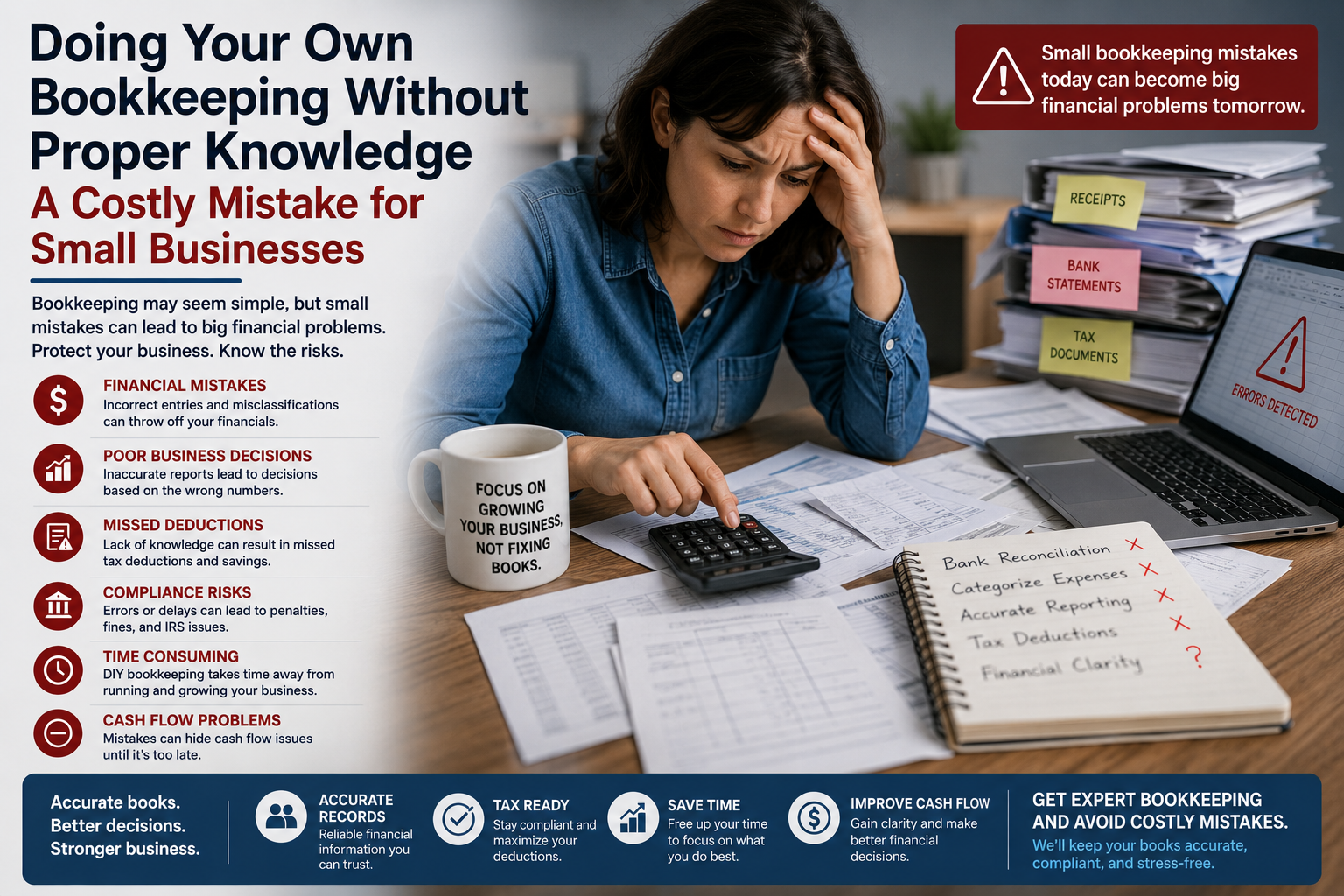

Running a business requires wearing many hats—but bookkeeping shouldn’t be one you “wing.” While handling your own books might seem like a smart way to save money, doing so without a solid understanding of accounting principles can quietly create bigger, more expensive problems down the road.
In this article, we’ll break down the risks of DIY bookkeeping without proper knowledge—and how to fix it before it impacts your business.
The Problem: DIY Bookkeeping Without Understanding the Basics

Many business owners start by managing their own books using spreadsheets or basic accounting software. On the surface, it feels manageable—until complexity creeps in.
Without a clear understanding of:
- Debits and credits
- Chart of accounts structure
- Revenue recognition
- Expense categorization
- Reconciliation processes
…it’s easy to make mistakes that compound over time.
What starts as a “simple task” can quickly turn into a financial blind spot.
Why It Hurts Your Business
1. Higher Risk of Costly Mistakes
Even small bookkeeping errors can have serious consequences:
- Misclassified expenses
- Duplicate or missing transactions
- Incorrect bank reconciliations
- Inaccurate profit and loss statements
These mistakes don’t just affect your records—they can lead to tax issues, penalties, and poor decision-making.
2. Misinterpreted Financial Data

If your books aren’t accurate, your financial reports are unreliable.
That means:
- You may think you’re profitable when you’re not
- You might overspend based on incorrect cash flow data
- You could miss warning signs of financial trouble
Bad data leads to bad decisions—and in business, that can be dangerous.
3. Wasted Time and Lost Focus
Time is one of your most valuable resources.
DIY bookkeeping without the right knowledge often results in:
- Hours spent fixing errors
- Repeatedly searching for answers
- Constant second-guessing
Instead of focusing on growing your business, you get stuck managing numbers you don’t fully trust.
How to Fix It (Without Losing Control of Your Finances)
The good news? You don’t have to choose between doing everything yourself and losing visibility entirely. There’s a smarter approach.
1. Learn Basic Accounting Principles
Start with the fundamentals:
- Understand how debits and credits work
- Learn how to read financial statements
- Get familiar with cash vs. accrual accounting
You don’t need to become an accountant—but you do need enough knowledge to understand what’s happening in your business.
2. Use Guided Accounting Software

Modern bookkeeping tools can simplify the process—but only if used correctly.
Look for software that offers:
- Automated transaction categorization
- Bank feed integration
- Reconciliation prompts
- Clear financial reporting
Platforms like QuickBooks or Xero are powerful—but they still require proper setup and oversight.
3. Hire a Professional When Needed
This is where many business owners hesitate—but it’s often the smartest move.
A professional bookkeeper can:
- Clean up messy books
- Ensure accurate financial reporting
- Save you hours every month
- Help you stay compliant with tax regulations
More importantly, they give you confidence that your numbers are right.
Think of it as an investment—not an expense.
The Bottom Line
Doing your own bookkeeping without proper knowledge may seem like a cost-saving decision—but it often leads to:
- Expensive mistakes
- Misleading financial insights
- Lost time and productivity
The better approach is balance:
- Learn the basics
- Use the right tools
- Bring in expert help when needed
When your books are accurate and up-to-date, you gain something far more valuable than savings—you gain clarity, control, and confidence in your business decisions.