
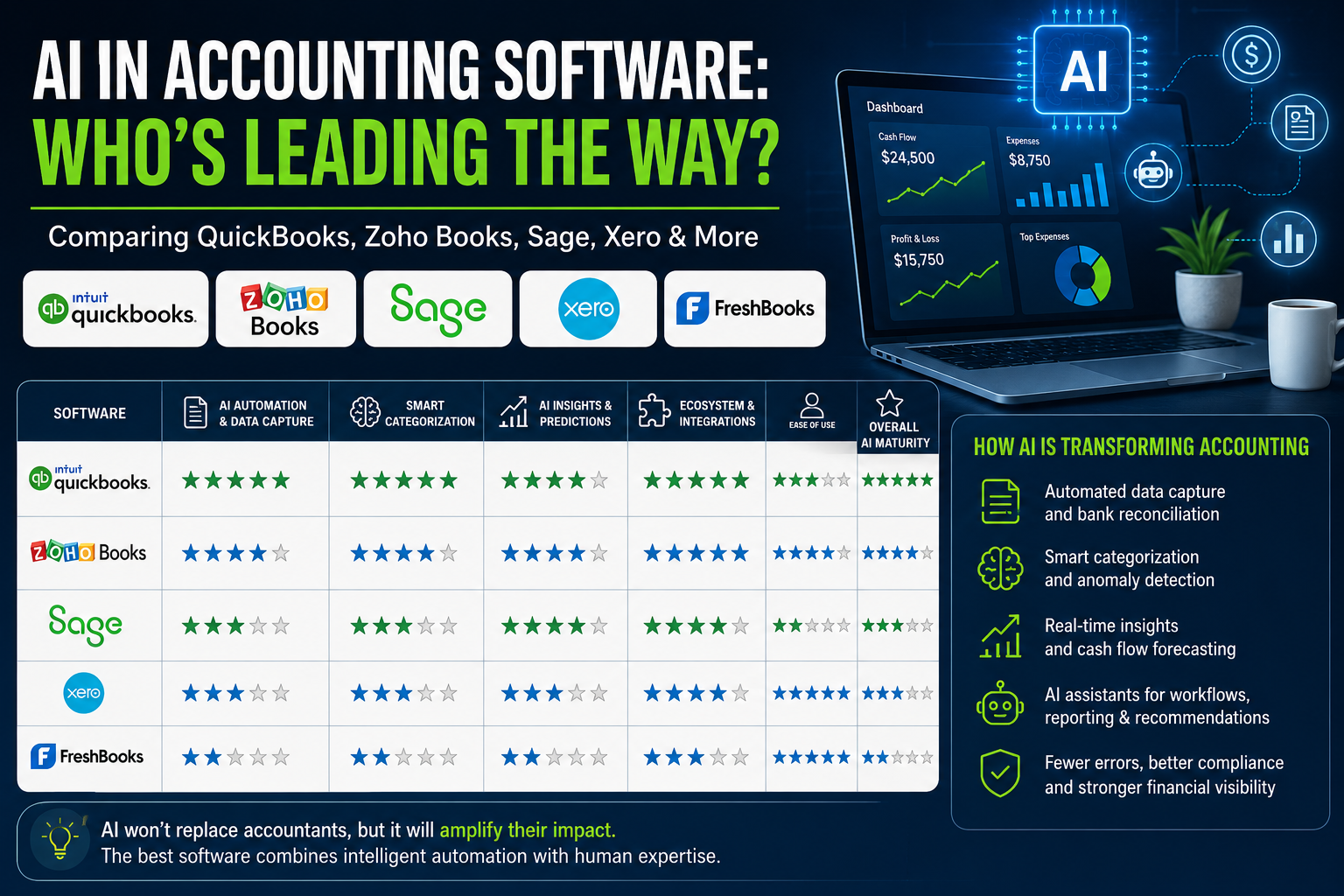

Artificial intelligence is rapidly transforming accounting software.
What started as simple automation—bank feeds, recurring transactions, and invoice reminders—has evolved into something much larger.
Today’s accounting platforms are aggressively integrating:
- AI assistants,
- predictive insights,
- automated categorization,
- anomaly detection,
- workflow automation,
- forecasting tools,
- and AI-generated recommendations.
Companies like:
- QuickBooks,
- Zoho Books,
- Sage,
- Xero,
- FreshBooks,
- and others
are all racing to position themselves as “AI-powered accounting platforms.”
But there is an important question small businesses need to ask:
Which accounting platforms are actually building useful AI systems—and which are mostly layering AI branding onto existing automation tools?
The articles published on Your Accounting Service Blog Posts frequently focus on:
- financial visibility,
- operational efficiency,
- KPI systems,
- forecasting,
- bookkeeping accuracy,
- and scalable financial management.
This article complements those themes by evaluating how AI is truly impacting accounting software today, where these systems are genuinely improving workflows, where they still struggle, and which platforms currently appear to be implementing the most practical AI tools for real-world businesses.
The Biggest Misconception About AI Accounting Software
One of the biggest misconceptions in the market right now is the belief that AI accounting software can operate autonomously with little oversight.
That is not the reality.
Most accounting AI systems today function best as:
- workflow accelerators,
- automation assistants,
- and financial visibility tools.
They still struggle with:
- accounting judgment,
- tax interpretation,
- operational context,
- and strategic decision-making.
This distinction matters because many software companies are marketing:
“AI accounting”
when what they are actually delivering is:
“enhanced automation.”
There is a difference.
True accounting requires:
- interpretation,
- business understanding,
- financial reasoning,
- and operational context.
Current AI systems remain highly dependent on:
- structured data,
- clean books,
- and human oversight.
QuickBooks: The Most Aggressive AI Expansion
QuickBooks is currently the most aggressive major accounting platform in terms of AI rollout.
Intuit has heavily invested in:
- Intuit Assist,
- AI agents,
- bookkeeping automation,
- predictive insights,
- and workflow intelligence.
The company is clearly attempting to position QuickBooks as:
an AI-powered financial operating system for small businesses.
Where QuickBooks AI Is Strong
QuickBooks currently leads in:
- AI transaction categorization,
- invoice reminder automation,
- anomaly detection,
- and AI-assisted workflow automation.
Its greatest strength is ecosystem maturity.
QuickBooks benefits from:
- massive transaction datasets,
- widespread adoption,
- strong integration depth,
- and years of bookkeeping pattern recognition.
This gives its AI systems more real-world financial training data than most competitors.
QuickBooks AI performs particularly well for:
- repetitive bookkeeping tasks,
- receipt processing,
- expense categorization,
- and cash flow visibility.
Where QuickBooks Still Struggles
Despite the aggressive AI rollout, many accountants and bookkeepers remain skeptical.
A recurring criticism is that:
some QuickBooks AI features feel more like “AI-branded automation” than true intelligence.
Common complaints include:
- bloated workflows,
- interface clutter,
- incorrect categorizations,
- and overcomplicated reconciliation experiences.
QuickBooks also struggles in:
- messy bookkeeping environments,
- highly customized accounting structures,
- and businesses requiring deeper operational nuance.
The software is improving rapidly.
But businesses should still avoid assuming the AI fully understands accounting context.
Zoho Books: Quietly Becoming One of the Most Practical AI Systems
While QuickBooks dominates attention, Zoho Books may actually be building one of the most practical AI ecosystems for small businesses.
Zoho’s AI assistant, Zia, focuses less on flashy AI branding and more on:
- workflow efficiency,
- automation,
- anomaly detection,
- reporting assistance,
- and operational automation.
Where Zoho Books Is Excelling
Zoho’s biggest advantage is ecosystem integration.
Because Zoho controls such a large suite of operational tools:
- CRM,
- projects,
- inventory,
- HR,
- email,
- analytics,
- and accounting
its AI systems can interact across business functions more effectively than many competitors.
That interoperability is extremely valuable operationally.
Zoho Books also performs well in:
- workflow automation,
- recurring transaction handling,
- approval workflows,
- and business process coordination.
Many users also prefer Zoho’s:
- cleaner interface,
- pricing structure,
- and customization flexibility.
Zoho Books Weaknesses
Zoho’s AI still trails QuickBooks in:
- accounting ecosystem maturity,
- accountant adoption,
- and advanced financial reporting depth.
While Zoho is excellent operationally, many accounting professionals still default to QuickBooks because:
- more accountants know it,
- more integrations exist,
- and more businesses already operate within the QuickBooks ecosystem.
Zoho also tends to perform best when businesses commit more fully to the broader Zoho ecosystem.
Standalone adoption can limit some of its advantages.
Sage: Strong Potential, But Mixed Execution
Sage has aggressively pushed AI through Sage Copilot and related AI initiatives.
The company’s focus is heavily centered on:
- enterprise workflows,
- financial forecasting,
- and operational intelligence.
Where Sage Performs Well
Sage tends to perform strongest in:
- larger operational environments,
- manufacturing,
- inventory-heavy businesses,
- and more complex financial structures.
Its AI initiatives appear more focused on:
- finance departments,
- controllers,
- and operational forecasting
than very small businesses.
Sage also benefits from strong ERP-style functionality compared to many smaller-business platforms.
Sage Weaknesses and Concerns
Sage’s AI rollout has faced criticism around:
- usability,
- workflow complexity,
- and occasional data/privacy concerns.
Some users also feel Sage’s systems:
- require steeper learning curves,
- feel less intuitive,
- and are not as user-friendly for smaller businesses.
Sage’s AI strategy currently feels stronger conceptually than practically for many SMB users.
Xero: Less Aggressive AI, Better User Experience
Xero has taken a noticeably different approach.
Rather than heavily marketing AI, Xero has focused more on:
- usability,
- automation refinement,
- and workflow simplicity.
Xero’s Biggest Strength
Xero may currently offer one of the cleanest operational experiences among major accounting platforms.
Users consistently praise:
- interface simplicity,
- team collaboration,
- unlimited user access,
- and workflow speed.
While Xero’s AI features are less aggressive, its automation often feels:
- more stable,
- less intrusive,
- and operationally cleaner.
For many businesses, that matters more than flashy AI features.
Xero Weaknesses
Xero still trails QuickBooks in:
- US accountant adoption,
- ecosystem dominance,
- payroll depth in some regions,
- and advanced reporting customization.
Its AI systems also currently feel less advanced than:
- QuickBooks,
- Zoho,
- or Sage.
However, Xero’s restraint may actually help avoid some of the “AI overload” problems competitors are experiencing.
FreshBooks: Strong Simplicity, Limited AI Depth
FreshBooks continues to position itself primarily toward:
- freelancers,
- consultants,
- and service businesses.
Its AI functionality focuses mostly on:
- invoicing,
- expense tracking,
- automation,
- and workflow simplicity.
Where FreshBooks Works Well
FreshBooks excels in:
- ease of use,
- invoice management,
- and simplicity for non-accountants.
For solo operators and smaller service firms, that simplicity creates real value.
FreshBooks Weaknesses
FreshBooks currently lacks the:
- deeper operational AI,
- advanced financial tooling,
- and ecosystem sophistication
found in larger platforms.
As businesses scale operationally, many eventually outgrow FreshBooks.
Which Platform Is Actually Implementing AI Best?
Right now, the answer depends heavily on business type.
Best Overall AI Ecosystem: QuickBooks
QuickBooks currently leads in:
- AI ambition,
- accounting automation,
- anomaly detection,
- and ecosystem scale.
However, it also suffers from:
- feature bloat,
- interface complexity,
- and occasional overengineering.
Best Practical Operational AI: Zoho Books
Zoho Books may currently offer the most balanced operational AI experience.
Its combination of:
- automation,
- ecosystem integration,
- workflow management,
- and affordability
makes it especially attractive for:
- operationally focused small businesses.
Zoho’s AI strategy feels more practical and workflow-centered rather than purely marketing-driven.
Best User Experience: Xero
Xero remains one of the strongest platforms for:
- operational simplicity,
- collaboration,
- and workflow clarity.
Its AI may be less aggressive, but many users value:
- speed,
- usability,
- and clean design
more than experimental AI features.
Best Enterprise-Oriented AI: Sage
Sage performs best in:
- larger operational environments,
- finance-heavy organizations,
- and more complex accounting structures.
Its AI strategy is ambitious but still evolving operationally.
The Real Future of AI Accounting
The future is probably not:
“AI replacing accountants.”
The more realistic outcome is:
AI reducing repetitive processing while humans focus more heavily on:
- analysis,
- advisory services,
- forecasting,
- operational strategy,
- and financial interpretation.
This aligns with broader research surrounding AI copilots in professional workflows:
AI systems tend to work best as acceleration tools rather than autonomous decision-makers.
The businesses benefiting most from AI today are usually the businesses that already have:
- strong bookkeeping discipline,
- clean financial systems,
- operational structure,
- and financial oversight.
AI amplifies system quality.
It does not replace it.
What Small Businesses Should Actually Focus On
Businesses choosing accounting software should stop asking:
“Which platform has the most AI?”
And instead ask:
- Which platform improves operational visibility?
- Which system supports scalability?
- Which workflows reduce friction?
- Which platform fits our operational complexity?
- Which ecosystem aligns with our business processes?
- Which system can our team realistically use consistently?
Because ultimately:
the best accounting software is not the one with the flashiest AI marketing.
It is the one that:
- improves clarity,
- supports decision-making,
- reduces operational friction,
- and helps the business maintain accurate financial visibility consistently.
That is still what matters most.
References
- Intuit Assist Overview
- QuickBooks AI Accounting Features
- Overview of AI Agents in QuickBooks Online
- QuickBooks Accounting Agent Features
- Zoho Books Official Website
- Sage Accounting Official Website
- Xero Official Website
- FreshBooks Official Website
- Forbes – Best QuickBooks Alternatives 2026
- TechRadar Zoho Books Review
- TechRadar QuickBooks Review
- Reddit Discussion – QB AI Does Anyone Actually Like It?
- Reddit Discussion – Switching From QuickBooks to Zoho Books
- Investors.com – Intuit Launches AI Agents for QuickBooks
- Research Study – User Perception of AI Copilots